

AM MÍOSACHAN -
THE CALENDAR

We cannot be certain what calendar the ancient Gaels used. They certainly did not use either the Julian or Gregorian Calendars. The Julian calendar was introduced in 45 b.c.e. by Julius Caesar as a reform of the previous Roman luni-solar calendar. The calendar had been so manipulated for political purposes that it had become completely useless. Rome never got to Ireland or most of Scotland and half of Wales so it is unlikely it was used before the conversion.
The Gregorian Calendar was introduced in October 1582 following the papal bull 'Inter Gravissimas' 'Among the most serious'. The primary reform was to change the calculation of leap days so that the calendar was closer to the tropical solar year of 365.2422 days compared to the Julian Calendar's 365.25. Obviously this calendar could not have been used by the ancient Gaels.


In his 'Natural History' Pliny, the Roman general and author talks about the Gaulish appreciation of Mistletoe. During this discussion he speaks about the Gaulish calendar.
"Chapter 95: Historical Facts Connected with the Mistletoe.
Upon this occasion we must not omit to mention the admiration that is lavished upon this plant by the Gauls. The Druids--for that is the name they give to their magicians -- held nothing more sacred than the mistletoe and the tree that bears it, supposing always that tree to be the robur. Of itself the robur is selected by them to form whole groves, and they perform none of their religious rites without employing branches of it; so much so, that it is very probable that the priests themselves may have received their name from the Greek name for that tree. In fact, it is the notion with them that everything that grows on it has been sent immediately from heaven, and that the mistletoe upon it is a proof that the tree has been selected by God himself as an object of his especial favour.
The mistletoe, however, is but rarely found upon the robur; and when found, is gathered with rites replete with religious awe. This is done more particularly on the fifth day of the moon, the day which is the beginning of their months and years, as also of their ages, which, with them, are but thirty years. This day they select because the moon, though not yet in the middle of her course, has already considerable power and influence; and they call her by a name which signifies, in their language, the all-healing. "
Natural History, Pliny the elder, trans Bostock, J. & Riley, H.T., Henry G. Bohn, London
The reference to the 'fifth day' was to the evening before the sixth as the Gauls, like all Celts start the day at sunset rather than sunrise or midnight.
In 1897 a bronze plaque wioth an inscribed calendar was found in Coligny near ain near Lyon was found. As well as the plaque broken pieces of a statue of a youth holding a spear was also found. Approximately forty percent of the calendar was recovered. The calendar lays out a five year cycle of a luni-solar calendar. Each year had twelve months of alternating 29 and 30 days length. An intercalary or embolismic month was added every two and a half years.
Eight fragments of a similar calendar were found at the shrine of Villards-d'Heria. Both calendars are laid out in a similar way to the 'Fausti Verulani' calendar found near Rome.
From the language and style its estimated both calendars are from the 2nd Century C.E. Some Celtic scholars believe the calendar was designed to fool the Romans into granting more market days than they would otherwise allowed.


There are some issues with the calendar as reconstructed. A lunar month or lunation is 29 days 12 hours and 44 minutes so a strict rotation of 29 and 30 days would send the calendar out of sync with the actual observances of the moon very quickly. Having an intercalary or embolismic month every 2.5 years means the calendar would be out of sync with the solar cycle as the correct period of intercalary months is 7 months in 19 years or one every 2.7 years.
However, as only 40% was recovered there may have been notations which altered the frequency of intercalary months which has not been recovered.

R.A.S. McAlister translated the Lebor Gabal Erenn, The book of the Takings of Ireland in 1941. The timings of the Takings, given in the book, can only work if the ancient Gaels were using a lunisolar or Metonic style calendar.
"God said unto Noe to come out of the ark on the 27th day of the moon of may [on the day before the Nones of May]."
"on the 27th day of the same secondary month (of May), he (Noe) came out of it (the ark): as regards the day of the week, on Friday"
"The interpolators (or one of them) apparantly supposed that the expression 'second month' implies that the May in which Noah entered the ark was an intercalary May (Mai atharrach). this is interesting, as it seems to indicate the recollection of a lunar calendar like that of Coligny. the calculation that he entered the ark on a Friday and left it on a Tuesday presupposes a lunar calendar with twelve months of 30 days:
13 x 30 + 16 = 376 = 7 x 53 + 5. the first of these extra five days being Friday, the last would be Tuesday: on this assumption therefore the calendar works"
The word 'atharrach' is a combination of 'ath' meaning 'again' or 'repeat' and 'arrach' meaning 'runt, spectre, dwarf' and which togethewr means 'strange, foreign, dwarf or alternate'. The Gaelic for May is Céitean, which means 'half' or 'period'.
Martin Brennan has done an extensive study of the lunar and solar alignments and symbols at Cnogba, Knowth. Stone K15 bears a fan shaped pattern with waves and seven circles. Another stone SW22 appears to bear solar symbols. Both seem to indicate a knowledge of the lunisolar Metonic Cycle. Cnogba, Knowth is surrounded by 18 satellite mounds, which together with Cnogba itself makes 19: The number of years in a Metonic Cycle.
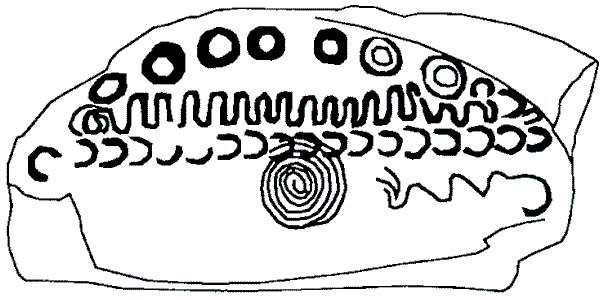

A Metonic calendar is named for the Greek mathematician, astronomer, geometer and engineer, Meton. Meton used his observations of the solstices and equinoxes to devise an accurate calendar which was inscribed on a stela near his observatory behind the Pnyx, Athens' Hill of the Assembly or 'parliament'.
The Metonic Cycle is a lunisolar calendar of nineteen years. The cycle has twelve years of twelve months and seven years of thirteen months. Each month has 29 or 30 days.
Although Meton created his calendar in the 5th Century B.C.E., the Babylonians had been using a similar system for at least two hundred years beforehand. The Jewish or Hebrew Calendar still uses the sytem to this day. According to Livy the ancient Roman calendar also used this method from at least the 8th Century B.C.E.
There is an ancient Irish myth which may indicate the use of such a calendar. Aislinge Ongusa, Dream of Aengus, tells how the God of Youth, Aengus or aonghas Óg has a dream where a beautiful girl would appear. Each time he reached out for her, she would disappear.
Aonghas falls into love-sickness for a year. He does not eat and waists away.
Fingen, Conchobar's physician diagnoses his condition and sends for Aonghas's mother Boann. Boann uses the rivers of Ireland to search for the girl for a further year but to no avail. They then send for his father an Daghda who calls for the help of his other son Bodhbh Derg after a further year. Bodhbh Derg takes another year to discover the name of the girl Caer Ibormeith, daughter of Ethal Anbuail of sidh Úamain in Connacht.


Ethal refuses to give Caer to Aonghas because "her power is greater than mine". Caer had the power to shape-shift into the form of a swan. She spent one year in human form and then one year in swan form, changing at Samhuinn.
Ethal tells an Daghda she would be in the shape of a swan from the following Samhuinn. an Daghda tells his son and he waits until the following Samhuinn. Aonghas travels to Lough Bel Dracon, Lake of the Dragon's Mouth. There he sees 150 swans. Aonghas calls out to her and she agrees to go with him to Brugh na Boinne, Newgrange on condition that she can return to the lake. Aonghas changes himself into a swan and they spend the night together. Thy then fly to the Brugh singing such sweet music that the whole of Ireland is put to sleep for three nights and three days. The three year - two year period is exactly that required for the insertion of embolismic months of a Metonic cycle. Years 3, 5, 8, 10, 13, 15, 18 would be embolismic and the rest normal.
Its likely the ancient Gaels used a Metonic or Lunisolar calendar before the Conversion. After the conversion the dates of the Great or Fire Festivals were fixed to the first day of each quarter. 1st November for Samhuinn; 1st February for Imbolc; 1st May for Bealltuinn and 1st August for Lughnasadh, which is known as the Gregorian Method. Many Celtic pagans follow this pattern.
There are similarities between the moon phase, Solar and Great festivals. The Gregorian dates often clash. Samhuinn should be at New Moon; Imbolc before First Quarter; Bealltuinn at Full moon and Lughnasadh at Last Quarter. A Metonic Calendar synchronises the festivals to the correct lunar phase. This is called the Metonic Method.
Some Celtic pagans prefer the Cross-quarter or Astronomical Method, where the Great or Fire Festivals occur at the mid-point between the equinoxes and solstices.

the vast majority of Celtic pagans accept the Four fire or Great Festivals, though their are arguments about the timing, duration and purpose of them. The Solar Festivals, equinoxes and solstices are far more controversial. Some pagans dont accept the Celts celebrated them at all. Our view is that they were commemorated but not in the same way as the Fire Festivals.
All the solar Festivals were euhemerised by the Christian Church. There are myths and folktales which explain their importance and symbolism. Each of them marks particular agricultural and pastoral actions which were important in the Bronze Age, Iron Age and Early Mediaeval periods. As with the Fire Festivals, the reasoning behind the festivals are explored in the pages for each.
Although the Metonic Method seems complicated, it is primarily about the observation of the moon's phases. The First Light of the New Moon is the start of the month and the Dark of the Moon marks its end. Everything else follows from that.
You can download the Metonic Calendar for this year using the button to the right.