

FÈIS CLÌAIR - FEAST OF THE WISPS
THE SUMMER SOLSTICE


CONDITIONS OF THE FESTIVAL
Summer is probably the happiest and brightest part of the year, as long as it doesn’t get too hot. In general, it’s a time of joy and celebration. Growth is everywhere and the countryside is a blaze of colour. The solstice is the longest day and shortest night of the year but also marks the point when days begin to get shorter.
June is one of the sunniest months of the year but not the hottest. About half the days in the month see rain and as temperatures rise there is a risk of thunderstorms and lightning. Winds tend to be warm and light.
Agriculturally it’s the time for sheep shearing. The solstice marked the end of the birthing season for cattle in the Iron Age through to the Early Mediaeval period. Hay making, an important source of winter animal feed, starts in June. Spring cereals are weeded. Many root crops and herbs are seeded this month.
Pine marten kits emerge to play in the sunshine. Badger clubs play in the evening moonlight. Grasshoppers fill the air with chirping. Moonwort produces spores this month and was credited with being able to unlock doors and take horseshoes off horses who tread on it. Foxgloves start flowering. Meadowsweet or meadwort is flowering and continues until the end of summer.
St. John’s Wort and Vervain are also flowering which were important both for their medicinal properties and their symbolism.


© Humpfrey Family Estate


CNOGBA & DUBHTHACH - KNOWTH & DOWTH
Obviously the most important astronomical event is the solstice itself. the solstice can occur on 20th, 21st or 22nd of June. The sun reaches its most northerly point rising between ENE and NE and setting WNW and NW, and begins its return to the south.
The Solstice is accompanied by the highest New Moon of the year and the lowest neap tides at the closest waxing or waning moons.
The aetiological myth for the summer solstice is contained in the Tale of Dubhadh or Dowth in the Dindshenchas of Cnogba. the first part of the dindshenchas talks about how Cnogba, Knowth gets its name from being the 'Hill of Bua of the Combats', daughter of Ruairi Ruad, wife of Lugh son of cian i.e. Lugh Lamhfhada. it hen goes on to tell how Midhir took englic, another of the wives of Lugh from Cnogba in order to prevent Aengus/Aonghas Òg, who was besotted with her, from meeting. This gives the alternative derivation as 'Hill of nut Wailing'. It then describes how Dubhthach, dowth got its name.
"12. there is another tale - 'tis known to me -
of that hill, which Dubthach possesses:
it was made, though great the exploit
by Bresal Bodibad.
13. in his time there fell a murrain on kine
in every place in Ireland
except for seven cows and a bull that increased strength
for every farmer in his time.
14. By him is built the solid hall
In likeness of Nimrod's tower
So that from it he might pass to heaven
- that is the cause for which it was undertaken.
15. The men of Erin came to make for him,
That hill - all on one day:
The wight exacted from them hostages
For the work of that day.
16. His own sister said to him,
She would not let the sun run his course;
There should be no night but bright day
Til the work reached completion.
17. His sister hies her on her way
Strongly she makes her druid spell:
The sun was motionless above her head.
She checked him on one spot.
18. Bresal came (lust seized him)
From the hill unto his sister
The host made of it a marvel
He found her at Ferta Cuile.
19. He went into her, though it was a crime,
Though it was violation of his sister:
On this wise the hill here
Is the hill here called Ferta Cuile.
20. When it was no longer day for them thereafter
(it was likely it was night),
The hill was not brought to the top,
The men of Erin depart homeward.
21. From that day forth the hill remains
Without addition to its height
It shall not grow greater from this time onward
Til the doom of destruction and judgement.
22. It is Fland here - bright his art -
Who tells the tale - no deceptive speech:
A choice story - spread it abroad, men and women!
Lips make mention of it among excellences."[1]
Anthony Murphy of Mythical Ireland and Martin Brennan have done extensive work cataloguing the celestial alignments at Dubhthach, Dowth; Cnogba, Knowth and Brúgh na Boinne, Newgrange. Their opinion is that the story of Dubhthach may represent the explanation of solar eclipses. However, the alignments and the story suggests an explanation of the Summer solstice.
[1] Cnogba, Metrical Dindshenchas, Vol. 3, Gwynn, E., Dublin Institute for Advancd Studies, 1941 (1906), Dublin
The two entrances at Dubhthach are primarily aligned with the lunar nodes. The northern passage entrance is aligned with Neolithic Southern Lunar Standstill sunset, which is aligned with the entrance of Newgrange. it is also aligned with the rise of Venus. It is also aligned to allow sunlight to penetrate the entrance at Imbolc and Samhuinn at sunset. There may have been another passage which intersected the northern passage, which may have been aligned with the Pleiades at the summer solstice. It was also aligned with the setting sun at Bealltuinn and Lughnasadh. It may also have been aligned with the Northern Minor Lunar Standstill. The axis is orientated to the Southern minor Lunar Standstill as seen over the entrance to Brúgh na Boinne, Newgrange.
The southern passage faces south-west allowing the setting sun to penetrate the southern chamber at the winter solstice. It is primarily aligned with the setting moon at Southern Major Lunar Standstill. In 2018 a further passage tomb was discovered at Dowth Hall, directly in line with Kerbstone 51, Stone of the Seven Suns. The henge is a horse-shoe shape aligned with sunrise at the summer solstice and sunset at the winter solstice.
The poem states the sun was 'motionless above her head, which suggests the sun at its zenith, which occurs at the summer solstice. Sun standing still, 'motionless', is the definition of 'solstice'. It goes on to say that he went 'From the hill unto his sister' and found her at 'Ferta cuile'. This may be a reference to the passage tromb and henge at Dowth Hall, which is aligned with the summer solstice. The 'Stone of the Seven Suns' may be a commemoration of an eclipse event at the summer solstice. Solar eclipses can only occur when the moon is completely dark at astronomical new moon, religious dark of the moon.

The entrances at Cnogba, Knowth are aligned to the east, meaning they would be aligned to sunrise at the equinoxes. Carn T on Sliabh na Caillig, Mountain of the Cailleach, Loughcrew is also aligned with the equinox sunrise and the nearest full moon. This connects Bui, the Cailleach with all the solar festivals. In Scotland, in particular, the Cailleach is patron of the wild herds including cattle. In a number of stories butter is her favourite food. In one story she butters a bannock, which may be an explanation for the moon's phases. In the Orkneys a series of hills opposite the Stones of Callanishare called Cailleach a mhòinteach, Old woman of the Moor. Once each Metonic cycle near the summer solstice she appears to give birth to the full moon.
CATHA MAGH TUIREAD CONGA -
FIRST BATTLE OF MAGH TUIREAD
If Bealltuinn occurs in the first week of may, the summer solstice occurs six weeks later exactly half-way between Bealltuinn and Lughnasadh.
According to the Lebor Gabala Erenn this was the time of the first Battle of Magh Tuiread or Battle of Magh Tuiread Cunga between the tuatha De Danann and the Fir bolg.
“Six weeks of the summer, half the quarter, had gone on the appointed day of battle. The hosts rose on that day with the first glimmer of sunlight. The painted, perfectly wrought shields were hoisted on the backs of brave warriors, the tough, seasoned spears and battle-javelins were grasped in the right hands of heroes, together with the bright swords that made the duels dazzle with light as the shining sunbeams shimmered on the swords’ graven groves.”[1]
The war with the Fir bolg is a fairly civilised affair compared to the battle with the Fomoire. The tuatha and fir bolg are cousins as they were both descended from Neimheadh. Bres meets Sreng of the Fir bolg and the two exchange weapons to ensure neither side has an advantage. Nuadha then sends Cairpre, Ai and Eadaoin as envoys to propose the peaceful division of Ireland. Each peoples would take half. The Fir Bolg rejects this.
Remarkably they then make each other weapons. The tuatha provide the fir Bolg with spears while the fir Bolg provide the tuatha with javellins. The day before the battle there is a hurling match between the two sides with 28 men a-piece.
The battle rages for three days. On the first day the Fir Bolg have the upper-hand. On the second day the Tuatha are triumphant. Dian Cecht's three brothers Oll, 'ample', Forus, 'foundation' and fir 'truth' get the secret of the Well of Healing. They then attempt to assassinate the High-King of the Fir Bolg Eochaird MacEirc but are killed.
At the end of the third day Nuadha engages Sreng in combat. Sreng cuts off Nuadha's right arm. an Daghda defends Nuadha and he is carried from the battlefield by fifty men. The following day Sreng challenges Nuadha to single combat. Nuadha says he will fight Sreng if Sreng ties up his right arm to match Nuadha's injury but Sreng refuses. The Tuatha offer Sreng his choice of provinces and peace is made between the two sides. Sreng chooses the province of Connacht.
[1] The First Battle of Moytura, Fraser, J., Eriu, Vol. 8, Royal Irish Academy, 1916
ÁINE - LADY OF THE WISPS
The festivities at CnocÁine are very well attested. The eve of midsummer was a time for feasting, dancing, bonfires and taking Cliar, a brand or wisp or torch round the fields to bless them.
Brands represented bringing the 'fire of the corn', the Brìgh, life-force of the sun to bless the fields and give the cereals the power to grow and mature. The bonfire represented the power of the sun and its smoke blessed and purified the surrounding fields.


Daneher reports that the traditions of the Midsummer fire were prevalent all over Ireland. Both communal and family fires were widespread. The familial fires were used more as a protective for the family, animals and land. There was a great rivalry as to who could build the biggest bonfire. The greater the fire, the greater the blessing and protection. Stealing material or placing items into the unlit piles was common. Although this was probably friendly or not so friendly rivalry and ‘high jinks’, taking away the toradh, substance was an aspect of competition.
You decreased the amount of smoke from the fire and therefore reduced the blessings of the growth of your rivals’ crops while increasing that of your own. [1].
In Northern Ireland these traditions were transferred to July 12th to celebrate the victory of the Battle of the Boyne.
One story from local folklore says that the revellers on one night stayed beyond midnight and Àine herself appeared. She thanked them for the honour but would they kindly leave so that Àine and her sith could have their own festivities. Later, the inhabitants of the Sith could be seen singing and dancing around the flames. In another the torch-lit procession to CnocÁine was cancelled one year due to death in a local family.[1]. Witnesses claimed they saw the inhabitants of CnocÁine themselves, performing the rite during the night led by Áine herself.
"Some say that Aine's true dwelling-place is in her hill; upon which on every St. John's Night the peasantry used to gather from all the immediate neighbourhood to view the moon (for Aine seems to have been a moon goddess, like Diana), and then with torches (_cliars_) made of bunches of straw and hay tied on poles used to march in procession from the hill and afterwards run through cultivated fields and amongst the cattle."[1]
The summer solstice marks the night that Áine retires in favour of her 'sister' Grian. The fierce sun of Summer gives way to the Pale sun of Winter. A time to thank Áine for giving 'fire' to the corn and to welcome Grian.

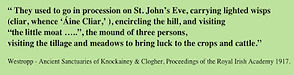

A connection between the sun and the moon was the warning that those who climbed the hill for the festivities must take account of the moon, or they will never return. The Solstice is the time of the highest New Moon and the lowest full moon of the year. Àine and Grian with their sisters are said to ‘ride out’ under the full moon. This may be a reference to the Hyades conjunction or the major and minor lunar standstills.
Although the practice of taking brands round the fields at the solstice is recorded in detail at Lough Gur, there are indications that it was a much more widespread.
The Carmina Gadelica defines cliar as follows:
“cliar. Reeds bound together by cords burnt by fisherman upon oidhche Fheill Sheathain, St. John’s Eve.”
The cliar was burnt generally upon the seashore, but sometimes in the boat at sea, while a ran, rune, was intoned to Righ na mara, king of the sea, to send fish. No word of this curious hymn is now obtainable. In Ireland the people practised the same rite.”
Rìgh na Mara, King of the Sea, must be Manannan. The blessings of the cliar was placed on both sea and land and was a widespread practice in both Ireland and Scotland.


Lady Wilde described the festivities as the fires burned low, which involved driving yearling cows through which was followed by men and women jumping backwards and forwards through the embers or ‘Beoil’. The word is connected to 'beall' [3]. This connects the summer solstice to Bealltuinn. The custom is also recorded in the Isle of Man.[2]
Hazel twigs blackened in the fire were used to direct cattle to water. Hazel connects the festival to both Manannan and to Imbolc and Bealltuinn through the Well of Segais.
The ashes and embers from the sacred fires were taken home and used to ensure health, prosperity and were placed in the corners of the fields, which also connects to the story of Grian and Connall. The fires in some areas were blessed with water.[4]


Daneher records one custom in Ireland, which is not present in Scotland.
“to come back to the point I wished to make clear I found after many enquiries that there was in old times a custom of burning in the Teine Feil’ Eoin things used in piseóga e.g. a spancel, eggs, meat, part of a dead animal or a piece of cloth left on a neighbours property with certain ceremonies to cause loss etc. to that neighbour.
It was also customary that small objects of piety such as rosary beads little statues or scapulas when they became broken or worn out, were destroyed without disrespect by being burned in the Midsummer fire.”
Àine is a Brian of passion, another expression of ‘fire’. Her mythos is filled with romantic encounters and she is said to ‘be free to choose her own husband’. This gives her enormous privilege at a time when marriage was a contract between families, clans or territories, not simply a matter of relations between two individuals.
She, as well as Nuadha, is credited as one of the ancestors of the Eoganacht. CnocÀine was the inauguration site for their kings. She punishes Aillil Aulom for raping her and killing her father. She has numerous lovers including the Earl of Desmond. In one story her brother arranges a tryst with Manannan in exchange for her brother having an affair with Manannan’s wife.

Statuettes of Manannan and Aine from Anient Gods Shop on etsy AncientGods - Etsy UK
At Bealltuinn there were prescriptions against sharing the necessities of life in case they were used for draoidheachd. The act of burning small items of piety seems to be designed to prevent their use in draoidheachd, as was stealing items from your rivals' fires.
Whereas gorse bushes were burnt on the Isle of Man at Bealltuinn, furze bushes would be set alight in Ireland and Scotland at Midsummer. This may have been a practical precaution against fire at the harvest. Furze and gorse are both highly oleaginous.


Àine can sometimes be seen on a crystal island in the middle of Lough Gur combing her hair next to a tree. On the tree is a green mantle blowing in the wind. one story tells of a young boy who tries to steal the mantle. As he strides across the lough, the waters rise up and pull him under and he is never seen again. The green mantle returns to its old place on the tree. As with Brighid the Green Mantle is symbolic both of Áine's fertility aspect and her healing aspect.
© Sue Wookey SueWookey.com Brigid of the Green Mantle
Close to Lough Gur and opposite Cnoc a Duin, which contains Fer Fhi's cave, there is a stone circle Lios na Grainsi, Court of the Grange. The entrance is directly aligned with sunrise on the summer solstice. The largest stone is known as Rannach Chruim Dubh, Division of Crom dubh, Black Crooked or Crescent One. It is aligned with sunrise at Lughnasadh. Crom dubh is the folkloric equivalent of Crom Cruaich from the Dindshenchas of Magh Slecht.


© Bryan Perrin
In folklore he often appears as a pagan chief, leader or druid who opposes priests abbots, bishops and even St. Patrick. Often his choice of weapon is an over-sized ferocious black bull. Of course, being mostly Christian propaganda his plots fail and he either slinks away defeated or converts.
The bull represents power, strength, and fertility. The gestation period for cattle is nine months so the Summer Solstice marked the last point for cows to be bulled to be born in the following late March/April. Calves born at that time would be ready for the Transhumance at Bealltuinn.
His name may come from the hump on a bulls back or it may come from a rare phenomena which occurs during eclipses, when the sun can appear to have a black crescent. The Grange Circle and offerings to Crom dubh at Lughnasadh connect the two festivals.
[1] Fairy-faith in Celtic countries, Evans-Yentz, W.Y., 1911, Oxford University Press, London
[2] Folklore of the Isle of Man, Moore, A.W., D. Nutt, 1891, Douglas Isle of Man & London
[3] Ancient Legends, Mystic Charms and Superstitions of Ireland, Boston, Tickmore & co., 1887
[4] The Year in Ireland, Danaher, K., Mercier Press, 2001 (1972)
MANANNAN
As god of the ocean, Manannan is celebrated at each of the equinoxes and solstices. The Summer Solstice is the time of the highest spring tides of the year at New Moon and Full Moon and then lowest Neap tides at the closest First and Last Quarters. One of Manannan's epithets is "He who reveals that which is hidden and conceals that which is evident".
The Corrbolg, Crane-bag is open at high tide displaying his eight treasures and closed when the tides are low.

© Kelly sue DeConnick

© Paul Marriot http://www.paulmarriottphotography.com/
Each year on the summer solstice the people of the Isle of Man would pay 'rent' to their king, Manannan. The rent consisted of rushes/reeds which would be laid at the top of Barool jiass, South Barule, the highest mountain on the island. Reeds and rushes connect all three realms earth, sea and sky. They also link the midsummer celebrations on the Isle of Man to those of CnocÁine. The taking of 'cliar' out to sea (see above) also connects the two.
Áine and Manannan are more directly connected as well. Her brother, either Aillen or Fer Fhi, depending on the version falls in love with one of Manannan's wives Uchtdelbh, 'Icon of Breasts', daughter of Aengus Finn. Áine offers to arrange a swap as she declares that Manannan has fallen in love with her, or maybe she had fallen in love with Manannan. Aillen and Áine go to the Cairn of Manannan also known as the Carn of the Seduction of the Wife of the Son of Ler, where they meet Manannan and Uchtdelbh When Uchtdelbh sees Aillen, she immediately falls in love with him. Áine sits on the right side of Manannan and gives him 'three fervent kisses' saying,
"O son of Lir come away with me to the oakwood of Dairbre in the heights,
Woodcock will call, a blackbird's song carry,
If you but reach the Bridge of Two Curs,
Much music will be played for you, notes both familiar and strange,
Cuckoo song springing from the dark wood at the lead stag's belling,
The lure of faint forest piping, woodpecker's drumming on a tree trunk,
Stags calling into the bracing wind, heather grouse in the cold night,
Listening to such soothing music with its many-noted performance,
This and lovely girls in our house, all for you son of Lir."[1]
Aillen takes Uchtdelbh to his father's sidh. Áine's entire family share CnocÁine. The father Eogabail and his wife Cacht in the west ; her brother Fer Fhi and his wife Eter in the south; her uncle Uanidhe and his wife Emer in the north and Aine on the east side. Meanwhile Manannan takes Áine to the Land of Promise.
In the Fenian Cycle Eogabail is called Manannan's steward, just as Ealcmhair is Nuadha's steward and Midhir is an Daghda's steward. Fer Fhi is described as 'Manannan's student' in the Dindshenchas of Inbir Tuag. There is clearly a strong connection between Manannan and Áine.
The myth could be an aetilogical explanation of the sunset. A prayer in the Carmina Gadelica seems to confirm it.
"Hail to thee thou sun of the seasons,
As though traverseth the skies aloft,
Thy steps are strong on the wing of the heavens,
Though art the glorious mother of the stars.
Thou liest down in the desctructive ocean,
Without impairment, without fear,
Thou risest up on the peaceful wave-crest,
Like a queenly maiden in bloom"[3]
It is possible the marriage of Áine and Manannan occurs at the Summer Solstice.
[1] Tales of the elders of Ireland, Dooley, A. & Roe, H., 1999, OUP, Oxford
[2] Silva Gadelica, O' Grady, S.H., 1892, Williams & Norgate, Edinburgh
[3] Sun of the Seasons, Carmina Gadelica, Carmichael, A., 1910, Floris books, Glasgow
The Summer Solstice is a time of joy, warm weather, happiness, love and the 'fire of the corn'. Áine gives growth to corn and man on land and Manannan on sea. The Eye of the Great God bestows its blessings on the land, plants, animals and humans.