

LUGHNASADH - COMEMMORATION OF LUGH

Courtesy of RhymeandRibbons.com
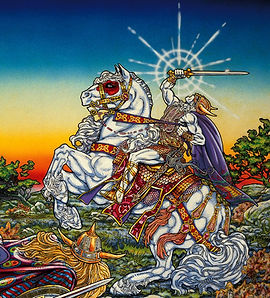
Courtesy of Jim Fitzpatrick
Courtesy of RhymeandRibbons.com
ORIGINS OF THE FESTIVAL
This is the last of the Great Festivals of the year, though probably the second most important of the Gaelic year. Of the 150 festival sites identified in Ireland the majority were occasions of assemblies at Lughnasadh. The name Lughnasadh comes from the Brian Lugh and the term Nasadh, derived from Nas, which means commemorative assembly, death and royal. Nasadh is specifically an assembly to commemorate a death of an important personage.[1] Nas, is the only one of Lugh’s wives who remains faithful.
The aetiological explanation of the festival is given as the commemoration of the deaths of Cliara Cetach, 'PBand of rushes, Poets following', Tailtiu 'Well-formed, Beautiful', Lugh’s foster mother; Carman and her sons, Fomoire opponents; Nas 'royal', one of his wives and Bui 'Victory', another of his wives.
Lughnasadh represents the entire agricultural process from clearing the land to reaping the ceareal crops. Like all the great festivals it is partly a thanksgiving for that which has already happened and a plea for protection for what is to come while celebrtating the present. At Lughnasadh we give thanks for the growth of crops and the Brianna in sustaining us, while hoping for good weather and fortune for the harvest.
DOMHNAICH CROM DUBH or LATHA CEARCALL
The first commemoration is Domhnaich Crom Dubh (Black Crescent Sunday) which is also known as ‘Garland Day’, ‘Bilbery Sunday’, or ‘Height Sunday’. Crom dubh is the folkloric equivalent of Crom Cruaich, ‘Crooked or Crescent, crooked stack’, which is the name of the ‘chief idol of Ireland’ from the Dindshenchas of Magh slecht.
Dindshenchas of Mag Slecht
MAG SLECHT
-
Here used to stand a lofty idol, that saw many a fight, whose name was the Cromm Cruaich; it caused every tribe to live without peace.
-
Alas for its secret power! the valiant Gaedil used to worship it: not without tribute did they ask of it to satisfy them with their share in the hard world.
-
He was their god, the wizened Cromm, hidden by many mists: as for the folk that believed in him, the eternal Kingdom beyond every haven shall not be theirs.
-
For him ingloriously they slew their hapless firstborn with much wailing and peril, to pour their blood round Cromm Cruaich.
-
Milk and corn they asked of him speedily in return for a third part of all their progeny: great was the horror and outcry about him.
-
To him the bright Gaedil did obeisance: from his worship—many the crimes—the plain bears the name Mag Slecht.
-
Thither came Tigernmas, prince of distant Tara, one Samain eve, with all his host: the deed was a source of sorrow to them.
-
They stirred evil, they beat palms, they bruised bodies, wailing to the demon who held them thralls, they shed showers of tears, weeping prostrate.
-
Dead the men, void of sound strength the hosts of Banba, with land-wasting Tigernmas in the north, through the worship of Cromm Cruaich—hard their hap!
-
For well I know, save a fourth part of the eager Gaedil, not a man—lasting the snare—escaped alive, without death on his lips.
-
Round Cromm Cruaich there the hosts did obeisance: though it brought them under mortal shame, the name cleaves to the mighty plain.
-
Ranged in ranks stood idols of stone four times three; to beguile the hosts grievously the figure of the Cromm was formed of gold.
-
Since the kingship of Heremon, bounteous chief, worship was paid to stones till the coming of noble Patrick of Ard Macha.
-
He plied upon the Cromm a sledge, from top to toe; with no paltry prowess he ousted the strengthless goblin that stood here.
Obviously, the account is full of Christian propaganda. No people could sacrifice a third of their first-born and survive and there is no archaeological evidence for such a practice. Crom means anything bent over, curved or a cresent. The name ‘cruaich’ is the same as the term cruach and cruachann and refers to a crooked heap or crooked mountain i.e. a mountain with jagged sides or peak. The name may refer to the appearance of the idol. A total of thirteen may be a reference to the thirteen months of the Metonic Calendar and therefore represents the year, which would suggest a solar connection and eternity, as a full year represents all time.
Crom Cruaich appears to become Crom Dubh in folklore. He appears as the arch-enemy of St. Patrick and other Christian clergy. Often, he is associated with a fierce, large black bull, which he gives to a clergyman with the intention of killing or maiming them. He attempts to throw St. Patrick into a fiery pit near Croagh Padraig at Downpatrick Head but instead St. Patrick douses the flames by hurling a blessed boulder into it. He then banishes Crom Dubh to Dun Briste (Cut off Fortress) which he separates from the mainland by slamming his crozier into the ground. Dun Briste and Downpatrick Head became major pilgrimage sites for Lughnasadh as was Croag Patrick.
Rannach Crom Dubh (Feast-giving, Black Crooked one or Crescent) is also the name of the tallest standing stone of Grange Circle near CnocAine. The standing stone was aligned with the summer solstice sunrise during the Bronze and Iron Ages. Again this suggests an ancient solar deity. The Grange circle consists of a number of large upright stones, just as Crom Cruaich and the twelve stones would have stood on Magh slecht.
The sun can appear as a crescent under certain specific circumstances. During an annular eclipse and a total eclipse the sun can appear as a crescent as the moon passes between the earth and the sun. In an annular eclipse almost the entire face of the sun is eventually a black disc. Another example is that the sun can appear as an upside down red crescent in the early mornings during an eclipse just before or after dawn. It is a rare phenomenon which can appear at sea or from the top of high mountains. One interesting word association is the term ‘Crom-shliabh’, (Crooked, curved or crescent-mountain) which is translated as ‘druid chapel’. The final week of July is marked by the oat harvest and Bilberries, whortleberries, heatherberries and blueberries become ripe.
Cattle are associated with the equinoxes, solstices, Bealltuinn, Lughnasadh and Samhuinn.
In general cows were bulled in April onwards until the end of June, which meant calves were born from late January until the Spring Equinox. Transhumance occurred at Bealltuinn and the Autumn Equinox/Samhuinn. Bulls were sacrificed at the Winter Solstice. Bealltuinn to Samhuinn was the period of cattle raiding but Lughnasadh marked a period of truce. Possibly this is why the bull was associated with the sun and cows are associated with the moon. The horns representing the crescents and the celestial bodies. The commemoration may be a means to celebrate and thank the sun for bringing Brìgh from the otherworld to give growth to corn and man.
Croag Patrick was formerly known as Cruachan Aigle (Crooked Heap of Aigle). The Dindshenchas records it as the site of the murder of Cliara Cetach, daughter of ‘the Scal bab’, another name for Cian, Lugh’s father. She is avenged by her protector Cromderg (Blood-red Crooked one or Crescent). The pilgrimage to Croag Patrick and other hill-top and mountain sites on Domhnaich Crom Dubh marked the start of the Lughnasadh festival. At CnocFirinn, Co. Limerick Munster; Grange Circle, Co. Limmerick, Munster; Slieve Naght, Co. Donegal, Ulster; Mount Brandon Co. Kerry, Munster: Slieve Donard, Co. Down and Church Mountain, Co. Wicklow garlands of wheat or oats were laid on the cairns at the top of the mountains and Rannach Crom Dubh.
As mentioned above this seems to be the commemoration of the death of Lugh’s sister. The first half of her name can be translated as either ‘band of poets or band of rushes’. This would also connect her to the summer solstice when such bands were lit and taken around the fields, to the shores and out to see as a form of sympathetic magic. One of Lugh’s epithets is ‘Chief Ollamh of Ireland’ due to his abilities at draoidheachd. So again ‘band of poets’ would be an appropriate name for his sister. The second half of her name means ‘hundred-fold’. Different grades of bard were permitted a certain number in their accompanying entourage. Having an entourage of over a hundred would indicate an especially high status.
The Dindshenchas of Cruachan Aigle
“¶1] Cruachan Aigle, whence the name? Not hard to tell. Aigle son of Derg, son of Connra, fell there by the hand of Cromderg son of Connra, because Cliara cétach whom Aigle slew while under the protection of Cromderg [...] Cruachan Garbrois was previously its name: but thenceforth it was Cruachan Aigle, ut dicitur in sequenti.
¶2] Aigle son of Derg (red his face); him Cromderg son of Connra slew: from that deed of savage force the name Aigle is given to Garbros.
¶3] Cruachán Garbrois the learned of this land used to call it: thenceforth its name is Cruachan Aigle, till the day of judgement.
¶4] Whence comes the name Cliara Cetach? let the shanachies of Connaught inquire: there was slain the Scal's daughter, and her attendants from Spain.
¶5] And Druimne, whence the name? There Luat was, the son of the Scal Balb: there his wife Bairend was killed, when sore disease broke her back.
¶6] Ecaill, that stands above the water—know ye whence the stronghold is called? Ecaill was killed there, daughter of Aed derg son of Lethderg.”
There seems to be quite a bit of death at this particular site. Aigle kills cliara Cetach and the ‘hundredfold’ attendants. Cromderg kills Aigle. Bairend dies from ‘sore disease’ as ‘druimne’ means ‘back’. Ecaill ‘that which causes fear’, is also killed there. There are also a lot of ‘red – Cromderg; aed derg (blood-red fire/passion), lethderg (half red) and Derg (blood-red). From the geneologies Connra is the father of Cromderg and grandfather of Aigle, which would make them uncle and nephew.
TAILTENASADH - COMMEMORATION OF TAILTE
Tailte is Lugh’s foster-mother, though how this comes about is a bit obscure. Her last request is that funeral games should be held in her honour at Lughnasadh. At her assembly the principal games were feats of strength, skill and chariot racing. Lugh is credited in the LGE with inventing fiodhchell, a form of ‘celtic chess’, assembling and horse-racing although horse-racing is also associated with Macha and Manannan.
The Dinnshenchas of Tailte gives the following account.
“When the fair wood was cut down by her, roots and all, out of the ground, before the year's end it became Bregmag, it became a plain blossoming with clover.
Her heart burst in her body from the strain beneath her royal vest; not wholesome, truly, is a face like the coal, for the sake of woods or pride of timber.
Long was the sorrow, long the weariness of Tailtiu, in sickness after heavy toil; the men of the island of Erin to whom she was in bondage came to receive her last behest.
She told them in her sickness (feeble she was but not speechless) that they should hold funeral games to lament her—zealous the deed.
About the Calends of August she died, on a Monday, on the Lugnasad of Lug; round her grave from that Monday forth is held the chief Fair of noble Erin
Unbroken truce of the fair the while through Erin and Alba alike, while men went in and came out without any rude hostility.
Corn and milk in every stead, peace and fair weather for its sake, were granted to the heathen tribes of the Greeks for maintaining of justice.
From the lamentation for Tailtiu of the Sele to the reign of Loegaire mac Neill was held by the fairy host a fair every single year,
By the Fir Bolg, who were there, and by the Tuatha De Danann, by the Children of Mil thereafter down to Patrick after the first coming of the Faith”[1]
This is confirmed in the Sanas cormaic, Cormac’s glossary and by Hyde, MacCulloch and MacNeil.
“or perhaps ‘Lugh’s memorial’ Lughnas is the 1st of august and the month has received its name in Irish from Lugh’s gathering.”[2]
“thus the gathering at Tailti on Lugnasad was said to be founded by Lug in memory of his foster mother Tailtiu and the Leinstermen met at Carman on the same day to commemorate King Garman, or in a varying account, a woman called Carman.”[3]
In fact, Garman dies at Samhuinn while trying to steal the queen’s crown.
“lughnasad i.e. a commemorating game or fair thereto is the name nasad i.e. festival or game of Lugh Mac Ethne or Ethlenn, which was celebrated by him in the beginning of autumn”[4]
It is also confirmed by the Dindshanchas of Nas and Cnogba as will be shown later.
As the pagan religious theology behind the festival receded from everyday consciousness, these gatherings became the main focus of the festival. Although the courting, marriage and harvest customs continued, the festival took on a more secular aspect of celebration. In the latter centuries particularly after the Cromwellian and further oppressions of Catholicism were implemented, the church attempted to refocus the celebrations into ‘patterns’. However, the Dindshenchas gives an insight into how the festivals were originally kept.
In describing the fair at Tailte, there are a series of events which give a more solemn account of proceedings.
Dindhshenchas of Tailte
Unbroken truce of the fair the while through Erin and Alba alike, while men went in and came out without any rude hostility.
Corn and milk in every stead, peace and fair weather for its sake, were granted to the heathen tribes of the Greeks for maintaining of justice.
From the lamentation for Tailtiu of the Sele to the reign of Loegaire mac Neill was held by the fairy host a fair every single year,
By the Fir Bolg, who were there, and by the Tuatha De Danann, by the Children of Mil thereafter down to Patrick after the first coming of the Faith.
Said Patrick, ‘Victorious was the proud law of nature; though it was not made in obedience to God, the Lord was magnifying it.’
Till Patrick came after Christ was held the fair of Tailtiu that subdues curses; many a dead man his mate bewailed in the graveyard of the wealthy Féni.
A tomb with one door for a man of art; a tomb with two doors for a woman; graves without doors
[...]
over lads and maidens.
Records from pillars over graves decked with arms, bearing of candles to watch the dead, mounds over noble foreigners, and walls built over the dead of great plagues.
p.155
For ever endures the wall of Tailtiu, where numbers of women were buried, and the wall that hides many dead, where Eochu Garb was buried.
On the wall of Eochu, compact of stones, twenty seats of the kings of Tara; and on the smooth wall of his wife twenty seats of their queens.
A royal chamber for mighty Munster to the left of the kings of Tara; the three parts of Connacht, not straitened, upon the seats of the men of Olnecmacht.
The warriors of Leinster, land of renown, between them and the province of Ulster; let us name them, from the right hand side: Erin, that belonged to her king in fee,
The Ulstermen, before the faith of the Cross, who came with their chariots to the first games, the Leinstermen before the men of Munster, and Connacht in well-remembered order.
The Stone of Grop, the Stone of Gar, the Stone of the Sick Men, the Leper's Stone beside the seats: the Rocks of Counting, the Wheel of Fal Fland, the Pillar of Colman, the Cairn of Conall.
Forbidden for Tailtiu is a cast at random; forbidden, to ride through it without alighting; forbidden, when leaving it for a meal, to look at it over the left shoulder.
p.157
A fair green with three marvels it possessed: a man without a head walking about it, the son of a boy of seven years, held on a finger, the fall of the priest from the air.
The three heinous spoils Patrick forbade in it; stealing of oxen in the yoke, slaughter of milch cows, burning of empty byres—no pristine tradition [he taught].
Patrick preached —so it is a judgement-—that none who did such things should find peace, so long as Tailtiu shall stand, for ever, so long as its royal raths endure.
The Eastern Rath, the Rath of the evil West, the Rath of Lugaid, the Rath of Lort, the Rath of Lorc, the Rath of Cú, the Rath of Canu—hail! the Rath of the Seed of Tadg, the triple rampart of Tailtiu.
The triple rampart of Tailtiu, famed beyond all lands, the spot where the kings used to fast, with laymen, with clerics, with hundreds of headmen, that no disease might visit the land of Erin.
In the triple rampart of Tailtiu, about tierce, Jesus granted to Mac Eirc to take away the three plagues from Erin—it is not unknown.
That the custom of gall-cherd should be put away, the sinking of the ships off Bregmag, and the pestilence of the sons of Aed Slaine: to Mac Eirc it was no disgrace.
There was a procession with candles to the graves of the great and good buried there.
The great and the good and those who died in plagues and war were honoured with the recitation of their grave stone markings.
Leaders would fast on the eve of the fair until ‘terce’ or 9am in order to prevent disease, famine, shipwrecks and plagues coming to Ireland.
Deiseil by the high-king and other leaders holding the fair three times.
Chariot-racing and wrestling and other sports of skill on the green
The Dinnshencas of Tailtiu[5] says “corn and milk in every stead, peace and fair weather for its sake, was granted to the heathen tribes of the Greeks for maintaining of justice”. Justice was a central theme of the fair. Lugh is after all the deity of oaths, marriages, commerce, contracts, and vengeance when they are broken. Tailte’s husband Eochaidh Garb is the first king in Ireland to ‘establish justice in his reign’. The Dinnshenchas emphasize how the fair were free of sin, fraud, reproach, insult, contention, seizure, theft, robbing trouble, dispute, reaving, suing, law-sessions, harsh levying of debts, satirising or quarrelling.
The fast appears to resemble troscud/trosgadh/sanadh, a fast for obtaining justice. The great and the good would sit on the ramparts of Teamhair and fast until the third hour after dawn or 9am. This appear to be similar to troscud/trosgadh/sanadh, a fast for obtaining justice. Except this fast was carried out at night rather than during the day.
Another surprising aspect is the emphasis on the dead. Lughnasadh in effect marks the start of the ‘season of the dead’, which continues until Imbolc. At Samhuinn we welcome and commemorate our relatives and ordinary people, at Lughnasadh it was the major figures of society – High-kings, kings, Queens, heroes, warriors, major poets/bards/filidh.
Given that Lugh is a deity of sovereignty, of unbridled war, of kings and warriors, so celebrating the rulers warriors and poets who were intimately connected to both royalty and war is appropriate.
Although there is a general and long-standing attachment to Oenach Tailtean being a ‘national’ festival, this has been the subject of long dispute. Binchty, Qiu and others have argued it was primarily a feature of the O’ Neill monarchy and the Dindshenchas itself says it was abandoned for some considerable time. We also have the contradiction that the text suggests everyone was present but the Dindshenchas of Carman cites that her festival was also.held at the beginning of August, which means most Leinstermen would have been at Carmun not Tailtean, every third year. There is considereable dispute about all the ‘National festivals’ – Feis Teamhro at Teamhair; Feis Uisneach at Uisneach and Feis Tailte at Baile Tailtean, as to when they should or were actually held. Given the evidence the most likely schema is as follows:
Feast of Teamhair Samhuinn every 7 years
Feast of Uisneach Bealltuinn every 7 years
Feast of Tailte Lughnasadh every year
Feast of Carman Lughnasadh every three years
[1] Metrical Dinnshenchas, Vol. IV, Gwynn, E., Dublin Institute for Advanced studies, 1991 (1906), CELT, Boucher, L. & Siewers, A. & O’Corrain, S., 2005/10
[2] A Literary History of Ireland, Hyde, D., T. fisher Unwin Ltd., 1899
[3] Religion of the Ancient Celts, MacCulloch, J.A., Morrison & Gibb Ltd., 1911
[4] Cormac’s Glossary, O’Donovan, J., Stokes, W., Irish Archaeological & Literary society, 1868
[5] Tailtiu, Metrical Dindshenchas, Vol. 4, Gwynn, E., Dublin Institute for Advanced Studies, 1991 (1941,1906), Dublin
CARMANNASADH - COMMEMORATION OF CARMAN
Caman is a ‘witch from Athens’, daughter of Dibad (Destruction, cattle-plague), son of Doirche (Darkness) son of Ancgeis (Great Taboo/prohibited act/magical imperative). She has three sons who come with her to Ireland Dian (power), Dothur (Evil) and Dub (Blackness).
“18. CARMAN.
There were three men who came from Athens and one woman
with them, [their mother]. The men were the three sons
of Díbad son of Doirche, son of Ainces, (‘Extinction son of
Darkness son of Ailment’), and their names were Dian and
Dub and Dothur. (‘Violent, Black and Evil’), and the
name of their mother was Carman.
By spells and charms and incantations the mother ruined
every place. By plundering and dishonesty the men destroyed.
So they went to Ireland to bring evil on the Tuatha Dé
Danann by blighting the corn of this island upon them. To
the Tuatha Dé Danann that seemed ill. So Ái son of Ollam
of their poets, and Cridenbé1 of their lampooners, and Lugh
Laebach of their wizards, and Bé cuille of their witches
went to sing charms upon them, and they parted not from them
till they had driven the three men over sea. And the men left
their mother Cairmen here as a pledge that they would not
come again to Erin, and they also gave the Seven Things
which they served (as security) that they would not come so
long as sea surrounded Ireland.
Their mother died of grief here in her hostageship, and she
asked the Tuatha Dé Danann to hold her fair (oenach) at her
burial-place, and that the fair and the place should always
bear her name. And the Tuatha Dé Danann performed this so
long as they were in Erin. Hence Carman and Oenach Carmuin.”[1]
Metrical Dindshenchas:
Carmun
Hearken, ye Leinstermen of the graves,
O host that rule Raigne of hallowed rights,
till ye get from me, gathered on every hand,
the fair legend of Carmun high in fame!
5] Carmun, gathering place of a hospitable fair,
with level sward for courses: —
the hosts that used to come to its celebration
conquered in its bright races.
A burial-ground of kings is its noble cemetery,
10] even specially dear to hosts of high rank;
under the mounds of assembly are many
of its host of a stock ever-honoured.
To bewail queens and kings,
to lament revenges and ill deeds,
15] there came many a fair host at harvest-time
across the noble lean cheek of ancient Carmun.
Was it men, or a man of mighty prowess,
or woman with passionate emulation,
that won a title of
[...]
without disrepute ,
20] and gave its proper name to noble Carmun?
Not men it was, nor wrathful man,
but one fierce marauding woman —
bright was her precinct and her fame —
from whom Carmun got its name at the first.
25] Carmun, wife of the son of fierce Dibad,
son of right hospitable Doirche of the hosts,
son of Ancgeis rich in substance,
was a leader with experience in many battles.
No supply of gain appeased them
30] in their ardent desire for noble Banba;
because they were distressed perpetually in the East,
the children of the son of Dibad and their mother.
They fared westward for the second time
— Dian and Dub and Dothur, —
35] from the East out of distant Athens,
they and Carmun their mother.
In the borders of the Tuatha De
the folk of a hostile wedlock ravaged
the fruit of every land to the shore:
40] it was a dreadful lawless pillage.
Carmun, by means of every spell of fame,
destroyed all sap of swelling fruit,
after strife waged with all arts unlawful,
and the sons through battle and lawlessness.
45] Then the Tuatha De perceived them;
horror and hideousness betrayed them
for every cruel deed they did,
the Tuatha De inflicted the like number upon them.
Crichinbel — no deception this!
50] and Lug Laebach son of Cacher
Be Chuilli into which I shall go above all battlefields
and Ai son of Ollam,
The stern four, equal-strong,
said to them on overtaking them,
55] "A woman is here to match your mother,
three men to the brothers three;
"Death to you — no choice ye would choose,
no blessing, no lucky wish!
or else leave with good grace a hostage;
60] depart from Erin ye three only!"
Those men departed from us;
stern means were found to expel them;
though it seemed distant to them, they leave here
Carmun — alive in her narrow cell.
65] Every pledge was given that is not transgressed with safety,
the sea with its beasts, heaven, earth with its bright array,
that the strong chiefs should not come southward
so long as the sea should be round Erin.
Carmun, death and yearning carried her off.
70] increase of mourning visited her
she found her fate, as was right,
among the oaks of the strong graves.
Thither came, for the delight of her beauty,
to keen and raise the first wailing over her,
75] the Tuath De over this noble plain eastward:
it was to the first true fair of Carmun.
The grave of Carmun, who digged it?
do ye learn, or do ye know?
according to the judgment of every esteemed elder
80] it was Bres son of Eladu: hearken!
Five fair hundred four score
years it is since then — no lie!
from Carmun, a captive under tribute,
to the psalm-sung birth of Jesus in human form.
85] Four hundred two and thirty
from the birth of Christ — not false the count!
to Crimthand ruler over captive Carmun
to Patrick great and glorious.
Five and thirty kings in the east without a curse
90] of the Leinstermen before the faith of Christ;
the noise of them reached over Erin
from thy sweet-omened haven, O Carmun!
Five and fifty kings — laborious these —
of the warriorhood of Christendom
95] from Crimthann, mark for wounds,
to Diarmait Durgen, stout and goodly:
Eight sons of Galam, with the number of their hosts,
Donn, Hir, Eber, Heremon,
Amairgen, unvexed Colptha,
100] Herech, Febria, and Erennan:
These were the warranties of the Fair,
loudly acclaimed at all seasons,
at coming in and at going forth
without any rude hostility.
105] From the Tuatha De to the children of Mil,
it was a refuge for noble ladies and princely men;
from the children of Mil ('twas a clear fact),
till Patrick of Ard Macha, it was a refuge.
Heaven, earth, sun, moon, and sea,
110] fruits of earth and sea-stuff,
mouths, ears, eyes, possessions,
feet, hands, warriors' tongues,
Horses, swords, chariots fair,
spears, shields, and faces of men,
115] dew, mast, sheen on leaf,
day and night, ebb and flow: —
The hosts of Banba, free from enduring sorrow,
gave all these completely as pledges
that it should not lie under gloom of disputes
120] to interrupt it, every third year.
The Gentiles of the Gaels held
often time with great acclamation
a Fair, without law, without sin,
without deed of violence, without impurity.
125] People of Christ's baptism, conceal it not!
hearken to him, for it is certain
men deserve a curse the more when they depart
from Christ and from Christianity.
Kings and saints of Erin there
130] around Patrick and Crimthand:
they it was who strictly checked every fight;
they blessed the Fair.
Nine fairs before the time of the Tuatha of active De
over the borders of well-famed Carmun:
135] fifty between them1, quickly,
from Herimon to Patrick.
Five times forty pleasant
glorious fairs in succession
from Bresal Broenach without treachery
140] till the final fair.
From Crimthand pure of beauty
to the high battle of violent Ocha
nine right famous fairs without division
held by the seed of heroic-gentle Labraid.
145] Sixteen kings, I am certified
by every sage, every glib shanachie, —
from Carmun of the winding harbours
did the host bring into the mighty fair.
Eight from populous Dothra,
150] a host of renown, ever boasted,
duly held the fair of Carmun
with pomp and with pure weapons.
Twelve without long possession of a share
in famous fairs, I own,
155] were of the falcon-like company of valour
sprung of the royal seed from great Maistiu.
Five from fierce Fid Gaibli
gathered above Carmun high in fame
a fair well-furnished with ranks of men,
160] with saddles, with bridle-horses.
Six men from Raigne of the races,
of the seed of Bresal Brec the smiter;
a fair-haired band for raidings of the west
over the cheek of hundred-wounding Carmun.
165] Patrick and Brigit together,
Caemgen and Columcille,
it is they that are warranty against every troop
that none dare assail their own troop of riders.
The fair of the saints in the first place,
170] strength to hold it and law to direct it:
the fair of the high kings with pure
it is this that comes next in order.
The game next day of the women of Leinster
from the radiant host — no false saying —
175] womenkind not small in esteem abroad;
this is their gathering, the third fair.
The Laigsi, the Fothairt, enduring their fame —
their turn was after the women's share:
Leinster with all her treasures is theirs,
180] the brave men set to guard them.
By honoured princes there
was held the fifth game in Carmun:
the honourable companies of Erin, however,
to them was firmly pledged the sixth.
185] Lastly by the Clann Condla was held
the game of well-protected Carmun:
noble was the compact beyond every host
above every triumph and royal revenue.
Seven games, as as thou art taught,
190] that is the charge Patrick left,
every day for a week set apart:
for the sake of your loved fame, steadily hearken!
The Leinstermen use to do on this wise
by tribes and by households,
195] from the days of Labraid Longsech, with number of hosts,
to powerful Cathair of the red spears.
Cathair of Carmun left nothing
save only to his mighty offspring:
at their head, with special wealth,
200] behold the seed of Ros Failge!
The seat of the noble king of Argatros
on the right of the pleasant, modest king of Carmun;
at his left hand, with no beggarly inheritance,
the seat of the king of bright-scioned Gaible.
205] The Laigsi are descendants of the seed
of mighty Lugaid son of Conall Cendmor;
and the Fothairt, whom drought visits not,
free from poverty to persecute them
On the kalends of August free from reproach
210] they would go thither every third year:
they would hold seven races, for a glorious object,
seven days in the week.
There they would discuss with strife of speech
the dues and tributes of the province,
215] every legal enactment right piously
every third year it was settled.
Corn, milk, peace, happy ease,
full nets, ocean's plenty,
greybearded men, chieftains in amity
220] with troops overbearing Erin.
Suing, harsh levying of debts,
satirising, quarrelling, misconduct,
is not dared during the races
[...]
:
absconding with a deposit, nor distraint.
225] No men to go into an assembly of women,
no women into an assembly of fair, pure men;
as for elopement, it is not to be heard of there,
neither a second husband nor a second family.
Whoever transgresses the law of the kings
230] Benen prescribed firmly for ever
that he should not thrive in his tribe,
but should die for his mortal sin.
These are the Fair's great privileges:
trumpets, harps, hollow-throated horns,
235] pipers, timpanists unwearied,
poets and meek musicians.
Tales of Find and the Fianna, a matter inexhaustible,
sacks, forays, wooings,
tablets, and books of lore,
240] satires, keen riddles:
Proverbs, maxims, the Rule
and truthful teachings of Fithal,
dark lays of the Dindsenchas for thee,
teachings of Cairpre and Cormac;
245] The feasts round the mighty Feast of Tara,
the fairs, round the Fair of Emain;
annals there, this is true;
every division into which Erin has been divided:
The tale of the household of Tara, that is not scanty,
250] the knowledge of every cantred in Erin,
the chronicle of women, tales of armies, conflicts,
hostels, tabus, captures:
The ten-fold Testament of hundreded Cathair
to his right pleasant offspring kingly of stature:
255] assigns the estate of each man as is due,
so that all may listen to it.
Pipes, fiddles, gleemen,
bones-players and bag-pipers,
a crowd hideous, noisy, profane,
260] shriekers and shouters.
They exert all their efforts
for the King of seething Berba:
the king, noble and honoured,
pays for each art its proper honour.
265] Tales of death and slaughter, strains of music;
exact synchronising of the goodly race;
his royal pedigree, a blessing through Bregmag
his battle and his stark valour
That is the sign for breaking up the Fair
270] by the fortunate ever-joyous host:
may there be given to them, from the Lord,
the earth with her pleasant fruits!
[...]
of the Leinstermen next day
the saint of the compact — no deceitful blessing —
275] above the hallowed water of Carmun, devoutly,
mass, genuflection, chanting of psalms.
A fast was held in autumn
in Carmun, all at once,
by the Leinstermen, not thinly gathered here,
280] against wrong and oppression.
Clerics and laymen of the Leinstermen there,
wives of the warriors assuredly,
God knoweth how they have deserved;
to their noble prayers He hearkens.
285] Hospitality of the Ui Drona next,
and horse-fights of Ossory,
and a shout raised with spear shafts
by the host there — that is the end.
Though we should call it Firt Mesca,
290] it were not raillery nor malice;
she and Sengarman the crooked, her husband,
it is there she was buried for eternity.
Even from them was it called
among leaguered hosts;
295] it belonged to them, without poverty, and they to it;
O Leinstermen of the graves, hearken!
One and twenty raths — their fame endures —
where lies the host under earth's sod,
and their count of graveyards right famous
300] where lies the beloved of noble Carmun.
Seven mounds next, unvisited,
for frequent keening of the dead,
seven plains, purlieus without a house,
under the funeral games of Carmun.
305] Three busy markets in the land,
the market of food, the market of live stock,
the great market of the Greek foreigners,
where were gold and fine raiment.
The slope of the horses, the slope of the cooking,
310] the slope of the women met for embroidery;
no man of the host of the noisy Gaedil
boasted of them nor reviled them.
There comes for neglect of it
baldness, weakness, early greyness,
315] kings without keenness or jollity,
without hospitality or truth.
There are similar elements which constitute the Oenach as with the commemoration at Tailte. It is a commemoration of the death of a woman connected to Lugh. However, this time it is a woman who, with her sons, blights the land and the crops instead of helping to grow them. Lugh once again acts as the protector of food supplies. He imprisons Carman and drives her sons away with the help of Ai MacOllam (poetic inspiration, son of all knowledge); Crichenbel (Boundary of Mouth), Be Chuille, (Wanton woman), who may also be Be chuma, who is banished from the Otherworld for adultery and then exiled from Ireland for the plotting against High King Conn Cetchathach. Ai is later mentioned in the Wasting Sickness of Cuchulain as one of the three members of the Tuatha who are killed by Fomorian kings, possibly in revenge for this episode. Lugh here is named as ‘a wizard’.
The four appear to represent different levels of filidh. Instead of a physical battle we can perceive this as a spiritual/magical battle. A poet, satirist, witch and druid combats Carmun and her progeny – Power, Evil and Blackness. This is also appropriate as Lugh is ‘Chief Ollamh of Ireland’.
As at Tailte there is a custom of visiting the graves of notables buried there. In particular the stories of kings and the Fianna are recited during the festival. There is also a fast but which is supposed to bring justice “against wrong and oppression”, rather than prevent disease. Again the holding of the feast guarantees cosmic order.
“Heaven, earth, sun, moon, and sea,
110] fruits of earth and sea-stuff,
mouths, ears, eyes, possessions,
feet, hands, warriors' tongues,
Horses, swords, chariots fair,
spears, shields, and faces of men,
115] dew, mast, sheen on leaf,
day and night, ebb and flow: —
The hosts of Banba, free from enduring sorrow,
gave all these completely as pledges
that it should not lie under gloom of disputes
120] to interrupt it, every third year.
The Gentiles of the Gaels held
often time with great acclamation
a Fair, without law, without sin,
without deed of violence, without impurity.”
One element was the settling of taxes, disputes and laws for the forthcoming three year period. The principle physical activity was a horse race on each day of the fair for different groups.
First Day Fair of the Saints
Second Day Fair of the Kings and high Kings
Third Day Fair of Women of Leinster
Fourth Day Fair of Laigisi & Fothairt
Fifth Day Fair of the Princes
Sixth Day Fair of the Fianna
Seventh Day Fair of Clann Condla
The Laigisi are also known as the Laigin and Gaileoin. The fothairt were a group from around Kildare, one of whose septs claimed to be descendants of Brighid. Clann connla occupied the Osraige territory on the borders of Leinster and Munster.
[1] Prose Tales in the Rennes dinnshenchas, Stokes, W., Revue Celtique, vol. XV., 1894
BUINASADH - COMEMMORATION OF BUI AND NAS
Dinnsheanchas of Nas.
“Nás took in hand a deed unwise:
(truth and not folly) death o'erwhelmed her;”
“15] 'tis from her Nás was named,
famous perpetually for stern law.
Nás of the Leinstermen, bright with splendid bounty,
'tis there the lady was buried;
from her it is called with clear certitude:
20] the lore of the ancient hides not this.
Her sister was at Cnogba free from ravage,
after the havoc of her shelter and her precinct:
not tardily came the death-dirge for the lady;
'tis there Bui abode, and was buried.
25] Cnogba is the Hill of Bui of the battles;
the pillaging violence of hosts does not wreck it;
but 'tis it that, for repose from fatigue of fierce deeds,
is the lofty hold of the fiery kings.
The hosts of the pure Gaels came
30] to bewail the women from the Brug;
from Tailtiu where he raised a fire
thence they came with Lug.
They lifted a cry of lamentation perpetually
for the women free from guilt and guile;
35] the game of wounds was waged by them
untimely, in no merry wise.
Thence grew the boasted gathering —
(it is not an empty lamentation with the lips)
the assembly of Taltiu with mighty preparations,
40] held by every hero moreover according to custom.
That was the gathering of accomplished Lug,
happy satisfaction, no small pleasure,
the lamentation of the fair-skinned vocal women of Fáil,
the keening for the daughters of Ruadri the red.”[1]
Metrical dinnshenchas
Nás
Ruadri, son of Aitte of the flocks,
was no faint splendour swift-passing yonder;
father-in-law of Lug with tale of ships,
with prowess of feats in war and slaying of foreign foemen.
5] The two daughters of Ruadri, the king
of Britain, of conquering white-clad forces
were the two wives of Lug, — fruitfulness came to them —
Bui of the Brug and modest Nás.
Nás, mother of Ibic of the horses,
10] claims of right the brow and the beauty of the spot,
since she is gone, with the noise of combat,
how should ye know at all the spot where she died?
Nás took in hand a deed unwise:
(truth and not folly) death o'erwhelmed her;
15] 'tis from her Nás was named,
famous perpetually for stern law.
Nás of the Leinstermen, bright with splendid bounty,
'tis there the lady was buried;
from her it is called with clear certitude:
20] the lore of the ancient hides not this.
Her sister was at Cnogba free from ravage,
after the havoc of her shelter and her precinct:
not tardily came the death-dirge for the lady;
'tis there Bui abode, and was buried.
25] Cnogba is the Hill of Bui of the battles;
the pillaging violence of hosts does not wreck it;
but 'tis it that, for repose from fatigue of fierce deeds,
is the lofty hold of the fiery kings.
The hosts of the pure Gaels came
30] to bewail the women from the Brug;
from Tailtiu where he raised a fire
thence they came with Lug.
They lifted a cry of lamentation perpetually
for the women free from guilt and guile;
35] the game of wounds was waged by them
untimely, in no merry wise.
Thence grew the boasted gathering —
(it is not an empty lamentation with the lips)
the assembly of Taltiu with mighty preparations,
40] held by every hero moreover according to custom.
That was the gathering of accomplished Lug,
happy satisfaction, no small pleasure,
the lamentation of the fair-skinned vocal women of Fáil,
the keening for the daughters of Ruadri the red.
45] The three sons of Dorchlam (strong testimony!),
Nás, Roncc and Ailestar
in the west without respite above troublous Cuan,
Taltiu engaged them for good.
A rath in Ulster (long the law);
50] a rath of the province of Connacht the excellent;
a rath of the province of Leinster without weakness,
a site for Nás daughter of Ruad.
Nas, which came to mean royal and was the site of a royal assembly as well as games during Lughnasadh, may be the figure of the Flaith Erenn, Sovereignty of Ireland, who appears
the Baile in Scail, who declares all the kings that will reign in Temhair after Conn Cétchathach after handing him a cup of red ale. Conn’s descendents rule from the 2nd to the 11th Century. Others have suggested the figure could be Eriu though she is married to Cetar or MacGreine. Nas may represent royal authority and the sovereignty of the land.
Nas dies when she ‘took a deed foolish in hand’ and ‘gone at the sound of combat’. Unfortunately, the poem does not state what the deed was nor what the combat refers to. Her sister’s name Bui means victory. The combat could refer to her sister’s rape as set out in the Dinnshenchas of Cnogba (Knowth) and Dubhthad (Dowth). All three monuments are connected by various celestial markers such as the summer solstice, winter solstice, major lunar standstills and the movements of the Pleiades. The building of Dowth may be the aetiological explanation both of the conjunction of the Pleiases and the Moon and the summer solstice. It may also refer to the Second Battle of Magh Tuiread or the killing of Lugh at Uisneach.
Dinnshenchas of Cnogba
Cnogba
Bua, daughter of Ruadri Ruad,
wife of Lug mac Cein of the red spears,
it is there her body was hidden;
over her was a great hill built up.
5] A hill had Bua in the midst of Bregia,
where the noble woman was laid,
in that spot yonder: —
the name of that hill is Cnogba.
But though easiest to utter
10] of its names be perfect Cnogba,
yet its more proper style is Cnocc Bui
down from Bua daughter of Ruadri.
Elcmar's daughter dwelt there:
Mider was the woman's darling:
15] a darling of her own was the prince,
the man from great and noble Sid Midir.
Englec, noble Elcmar's daughter,
was the darling of perfect Oengus;
Oengus, son of the loved Dagda,
20] was not the maiden's darling.
The illustrious Mac in Oc came
southward to Ceru Cermna
on the blazing hurrying Samain
to play with his fellow-warriors.
25] Mider came — alas the day!
he came upon her after they had gone,
he carries off with him Englec from her home
thence to the Sid of the men of Femen.
When noble Oengus heard
30] of the pursuit of his darling,
he went in search of her (I say sooth)
to the famous hill whence she was borne off.
This was the food of his band — bright feast —
blood-red nuts of the wood:
35] he casts the food from him on the ground;
he makes lamentation around the hillock.
Though it be called the Hill of Bua of combats,
this is the equal-valid counter-tale:
we have found that hence
40] from that 'nut-wailing' Cnogba is named.
By us is preserved together
the memory of the lay,
and whichever of these tales ye shall prefer
from it is named the region of surpassing worth.
45] There is another tale — 'tis known to me —
of that hill, which Dubthach possesses:
it was made, though great the exploit,
by Bresal Bodibad.
In his time there fell a murrain on kine
50] in every place in Ireland,
except for seven cows and a bull that increased strength
for every farmer in his time.
By him is built the solid hill
in the likeness of Nimrod's tower,
55] so that from it he might pass to heaven,
— that is the cause why it was undertaken.
The men of all Erin came to make for him
that hill — all on one day:
the wight exacted from them hostages
60] for the work of that day.
His own sister said to him,
she would not let the sun run his course;
there should be no night but bright day
till the work reached completion.
65] His sister hies her on her way
strongly she makes her druid spell:
the sun was motionless above her head;
she checked him on one spot.
Bresal came (lust seized him)
70] from the hill unto his sister:
the host made of it a marvel:
he found her at Ferta Cuile.
He went in unto her, though it was a crime,
though it was violation of his sister:
75] on this wise the hill here
is called Ferta Cuile.
When it was no longer day for them thereafter
(it is likely that it was night),
the hill was not brought to the top,
80] the men of Erin depart homeward.
From that day forth the hill remains
without addition to its height:
it shall not grow greater from this time onward
till the Doom of destruction and judgment.
85] It is Fland here — bright his art —
who tells this tale — no deceptive speech:
a choice story — spread it abroad, men and women!
lips, make mention of it among excellences!
The middle of the month was euhemerised into a festival of the virgin Mary, as goddesses were associated with the harvest throughout Europe. This in effect replaced the nasadh for Bui. This appears to be confirmed in the Dinnsheanchas of Nas as it says
“from Tailtiu where he raised a fire
thence they came with Lug.
They lifted a cry of lamentation perpetually
for the women free from guilt and guile;”
This suggests that the nasadh for Nas and Bui was held after the nasadh of Tailte and Carman. One interesting point is, the dinnshenchas of Tailte and Carman do not mention the ‘raising of a fire’ but the Dinnshenchas of Nas seems to suggest that a fire was raised.
In the Lament of the Hag of Beira we are told the cailleach’s name is Bui. Bui, as the Cailleach, is the epitome of age and wealth, partly due to her extreme age, symbolising both the wealth of the earth in terms of minerals and as the source of food through the crops, which grow from the earth. In folklore from both Ireland and Scotland, the Cailleach is represented as the greatest reaper of the corn. One story involving Donnchadh Mor MacManais explains that she got her powers from a smith, who gave her a magic black dog and a magic beetle, which she kept in the handle of her sickle. The milk of the magic dog gave her the strength and speed of sixty while the beetle made her unmatched at reaping. Donnchadh gains the secret from feigning love to the Cailleach’s daughter, who is the daughter of the magician-smith. At the end of the story the Cailleach becomes ill after telling Donnchadh her story. The house is struck by thunder and lightning and the Cailleach her daughter, dog and beetle are all killed.[2]
Although Lugh has the knowledge of when to sow, plant and reap, it is the Cailleach who is the patron of the act of reaping. This is why the Cailleach’s icon is given to the farmer who finishes his reaping last. The farmer is supposed to ‘maintain’ the Cailleach through the winter, which is seen as a burden but at ploughing the Cailleach tied to the plough-team’s harness would bring good luck.
The farmer maintains the Cailleach with offerings during the winter and in return the Cailleach grants him a portion of her abilities. The dog may represent health and strength. The golden apples of Lough Erne also feature a black otherworldly dog, who brings fortune to Connacht. Partholon commits the first jealousy in Ireland by suspecting his wife of ‘behaving amiss’ with his servant Toba. As a result he kills his wife’s dog Saimer, which becomes the name of an island and a river.[3] Brighid sends her greyhounds to guide the soul to the House of Donn. Dogs’ saliva contain a natural anti-septic so this may explain why they are linked to health.
The beetle could represent various forms of the insect that attack grain crops so depressing yield. Perhaps, this is a bit of sympathetic magic. A beetle which destroys crops being used by a reaper to enhance their power. Another candidate would be the Devil’s coach-horse beetle, which lives in grasslands but feed on invertebrates. The beetle can give a nasty nip and its larvae come up from the ground. In Ireland it was believed to kill on sight and when it raised its tail it was casting a curse. It can emit a foul smell and exude a foul-smelling brown liquid from its mouth.[4]
After revealing her secret, the Cailleach becomes ill and dies. Once the secret of the Otherworld is revealed, the personage cannot remain in our world. Her home is destroyed by thunder and lightning, two enemies of the harvest, as thunder represents storms and lightning cause fires.
Evidence from folklore, such as in the Carmina Gadelica, suggests harvesting was limited to the first half of the month as the sap, juice and taste or Brìgh and toradh of the crop went down into the roots. If this is the case, then commemorating the first cut at full moon would make sense, the power of the moon and sun combining to further enhance the final period of growth, and that Commemoration of Lugh itself occurred at the waning moon as a celebration. This would also make sense in terms of the cultivation of emer wheat, which was the main cereal crop, and which ripens in August. It would also explain why the entire month was named for the festival.
[1] Metrical Dinnshenchas, Vol. III, Gwynn, E., Dublin Institute of Advanced Studies, 1991 (1906), CELT, Faerber, B & Hazard, B. & O’Corrain, S., (comp)
[2] An Sgeulaidhe Gaidhealach, De Hyde, D., 1895
[3] Metrical Dinnshenchas, Vol. IV, Gwynn, E., Dublin Institute for Advanced Studies, 1991 (1906)
[4] Devils Coach-horse, UK Safari, Bradley, G., 2020it i
LUGHNASADH - THE COMMEMORATION OF LUGH
Dinnshenchas of Loch Lugborta
“LOCH LUGBORTA
¶1] Loch Lugborta, whence the name? Not hard to say. A great meeting was held at Caendruim (which is called Usnech) between the three sons of Cermait, the Dagda's son, and Lug son of Ethne, to make peace with him in regard to their father Cermait, whom he had slain through jealousy about his wife. Now the sons of Cermait, namely, Mac Cuill, Mac Cecht, and Mac Greine, had laid a plot to kill Lug. Mac Cuill thrust a spear into his foot. Then Lug escaped from them by his prowess to yonder lake. There he was killed and drowned; and they say that the cairn which stands on the shore, called the Sidan, was raised over his body: so that cairn is Lug's Grave, and hence come the names Loch Lugborta and Carn Lugdach.
¶2] Or else the lake was named after Lugaid mac Táil, who was called Delbaeth. For that territory was the place that Delbaeth mac Táil took possession of, when he came northwards out of Munster with his five sons, after being warned by his own daughter to give up his land to her and her husband, Trad mac Tassaig. Then Delbaeth lit a magic fire, and five streams burst forth from it; and he set one of his sons to watch each of the streams, namely, two of his sons to the west of Loch Oirbsen, Gno beg and Gno mór: Baetan at
Bethra, Andiled at Delbna Mór, Anlenn at Delbna Nuadat. He himself stayed at that spot, and it may be from him that the lake and the place had their name, Loch Lugborta, for till then his name was Lugaid, but thenceforth Delbaeth, that is Dolb-aed, from the enchanted fire.”
The last event in the cycle is the death of Lugh himself. The Three sons of Cearmaid kill Lugh using the Triple Death though the second element is not named. MacCuil (Son of the Hazel) puts a spear through his foot. The spear being Lugh’s own weapon. He is then killed and drowned.
THE MONTH OF LUGHNASADH
The schedule for the month becomes Domhnaich Crom Dubh on the last quarter moon of an t-Iuchar, Religious New Moon: nasadh for Taillte; nasadh for Carman every third year; full moon: nasadh for Nas and Bui and then at waning Moon the nasadh for Lugh. As Bui is the Cailleach it also makes sense in terms of her connection to the moon and in particular full moon as well as her connection to Bannocks.
The mediaeval and early modern custom is that Lughnasadh is a single night’s celebration, either the last Sunday in July or first Sunday in August, though at least some sites talk of the first and second Sundays being the dates. The Fair of Muff in Cavan is a fair which can be dated by charter to 1608 but is claimed to be able to trace its lineage back to the original Lughnasadh fair. The fair is for three days and a fourth if the first day is a Sunday. Some sources suggest the assembly at Tailte lasted for two or three weeks. Sophie Bryant mentions the ‘treena of tailten’,[1] which I believe is the word ‘trian’ meaning a third, which implies the festival lasted three days or three weeks.[2]
One reason the waning moon would have been commemorated is Cruachan Aigle/Croag Patrick. Twice a year on roughly April 18th and august 24th, the sun appears to roll down the side of Cruachan Aigle. When viewed from Killadangan the sun appears to set into a niche on the mountain at the winter solstice. The area around it is littered with neolithic and Bronze age monuments so it is likely the east- west pilgrimage trail is of great antiquity. This would explain why Cruachan Aigle is the site of pilgrimage at Domhnaich Crom Dubh, as that occurs at the start of the ritual month, while the rolling sun phenomena occurs at the end.
Domhnaich Crom Dubh Last quarter of an t-Iuchar`
Religious New Moon Start of Autumn
First week Tailtenasadh & Carmannasadh
Full Moon Buinasadh
Waning Moon Last Quarter Lughnasadh
Last three days of the month Dark of the Moon
In terms of mythology, Crom Dubh celebrates the ripening power of the sun. Tailte dies from clearing the ground in preparation for agriculture. Nas dies ‘at the sound of combat’. Bui dies either because the Daghda kills her for her affair with Cearmait, honey-mouth or she dies on hearing of her sisters’ death. Lugh is killed by the three sons of Cearmaid – MacCuil, MacCecht and MacGreine – son of the hazel, son of the plough, son of the sun, in revenge for the killing of Cearmait.
It is tempting to see this as a mythopoetic complex about agriculture. Crom Dubh represents the power of the Otherworld to give growth to cereal crops. Tailte represents the first stage of clearing the land. Nas represents the ploughing of the land, with the ard or ploughshare representing weapons and the battle being the hard work of turning over the soil. Cearmaid would represent pollination through his epithet and his given name both meaning honey-mouth. Lugh represents the harvest. While the three sons of Cearmaid represent threats to the crops from encroachment of woods, ploughing under, and burning from the sun.
They may also represent three things needed for the harvest – knowledge, skill and the energy of the sun, instead.
Lugh’s other two wives – Englic and Eachtach are not commemorated. Perhaps their adultery disqualifies them. Lugh is quite a vengeful figure. Bui does get games even though she possibly commits adultery with Cearmait and the Daghda. The poem of Nas above says the two sisters were ‘free of guilt and guile’, which seems to contradict both the Dinnsheanchas and ‘How the Daghda Got His Magic Staff’. The poems of Flann Mainstreach suggests only Echtach commits adultery. The Death-tales of the Tuatha suggests that Lugh’s druid, Abhean may have lied about the affair, which would then make Bui an innocent victim. Echtach gives an Daghda ‘his swift son’, which may be a reference to Aedh, who is killed by Corrgenn. Corrgenn’s wife falls in love with Aedh. Corrgenn’;s home is named as Cruachan Aigle, which seems more than a coincidence.
“Echtach, daughter of the Daghda of white smoke,
Englic, Nas Bui without treachery,
These are the wives of Lugh of many troops[3]
There is a degree of confusion concerning who does what with whom. Eachtach may actually be the daughter of Lodan, son of Manannan. Englic ends up with Midhir presumably before Midhir woos Eadaoin, yet Fuamnach, Midhir’s first wife is not mentioned.
[1] Celtic Ireland, Bryant, S., General Books LLKC., 2010, (Trench, 1889)
[2] Trian, Gaelic Illustrated Dictionary, Dwelly, E., Gairm Publications, 1994 (1901)
[3] Yellow Book of Lecan
CUSTOMS OF THE FESTIVAL
There are a large number of customs associated with Lughnasadh in the Goidelic countries. Like Bealltuinn, many customs were celebrated outdoors. Pilgrimages to high places were common. H.S. Swan describes a gathering on Slieve Naght, the highest mountain in the Inishowen Peninsular. Local people have described the gathering on Cnocfirinn. Helen roe described such a gathering on Ard Erin in Offaly. Maire MacNeill has surveyed 78 such gatherings in all the provinces of Ireland. This practice is also confirmed in the Carmina Gadelica in Scotland and the Folklore of the Isle of Man. There were also gatherings at loughs and wells and rivers, some of which involved driving cattle through the waters. According to tradition cattle that weren’t blessed in this way would not survive the year. The practice is recorded from 1680s through to the twentieth century.
The middle of the month was given over to visiting holy wells associated with the Virgin Mary, who in this instance may have stood for an euhemerised version of Bui, the Cailleach.
The festival of St. Latiaran also involved visiting holy wells and occurred at the same time as Crom Dubh Sunday. In Scotland barns, cattle sheds and shieling huts were blessed with holy water using a ‘sop seile’ (wisps of straw). At the Feast of Tailte, the loch was used to bless hand-fasted marriages and separations of those marriages.
In some locations lumps of butter were given into lochs and rivers, which may have been a reference to Bui or because butter has the same colour of the sun. As well as butter horse halters, bridels and other equipment were also deposited in lochs and rivers. This ,may be a reference to the creation of Lochs Ribh and Neagh in the dindshenchas. Flowers, garlands, bilberries, heatherberries and blueberries were offered on the mountain tops. This may have evolved into the offering of Bairn Breac or Speckled Bread, which contained those berries.
In Scotland a special Bannock, Bonnach Lunastain, was baked and offered and pieces were placed in the corners of animal shelters to protect them from misfortune.
The fire of Lughnasadh does not seem to have major religious symbolism. There is no description of the kind of care and attention given at Bealltuinn or Samhuinn. This may be a degeneration from pagan tradition. As mentioned above fire is alluded to, so it may be that the descriptions of the fairs at Tailte and Carman had dispensed with a pagan practice. The fires lit on the hilltops seem to be more practical in keeping everyone warm and comfortable to continue the ceilidh. Boys are said to have raced round them and even jump through the flames. No mention is made of girls and women doing it unlike at the summer solstice. However, it may also have a reference in the Song of Amairgin. One of the six questions is:
Coiche nod gleith clochur slébe?
Who understands the grazing of the stones of the mountains?
This may be a reference to the grazing of flint which was one way of creating a ‘teine eigin’ or need-fire, which was the traditional way of lighting a sacred fire.
In Scotland the start of the harvest began a little later than in Ireland. Usually at the Assumption. This was marked by a ceremony called ‘The Reaping Salutation’
“THE day the people began to reap the corn was a day of commotion and ceremonial in the townland. The whole family repaired to the field dressed in their best attire to hail the God of the harvest.
Laying his bonnet on the ground, the father of the family took up his sickle, and facing the sun, he cut a handful of corn. Putting the handful of corn three times sunwise round his head, the man raised the 'Iolach Buana,' reaping salutation. The whole family took up the strain and praised the God of the harvest, who gave them p. 247 corn and bread, food and flocks, wool and clothing, health and strength, and peace and plenty.
When the reaping was finished the people had a trial called 'cur nan corran,' casting the sickles, and 'deuchain chorran,' trial of hooks. This consisted, among other things, of throwing the sickles high up in the air, and observing how they came down, how each struck the earth, and how it lay on the ground. From these observations the people augured who was to remain single and who was to be married, who was to be sick and who was to die, before the next reaping came round.
p. 246
p. 247
DHE beannaich fein mo bhuain,
Gach imir, cluan, agus raon,
Gach corran cama, cuimir, cruaidh,
Gach dias is dual a theid ’s an raoid,
Gach dias is dual a theid ’s an raoid.
Beannaich gach murn agus mac,
Gach mnaoi agus miuchainn maoth,
Tiuir iad fo sgiath do neairt,
Is tearmaid ann an teach nan naomh,
Tearmaid ann an teach nan naomh.
Cuimrich gach mins, ciob, is uan,
Gach ni, agus mearc, is maon,
Cuartaich fein an treuid ’s am buar,
Is cuallaich a chon buailidh chaon,
Cuallaich a chon buailidh chaon.
Air sgath Mhicheil mhil nam feachd,
Mhoire chneas-ghil leac nam buadh,
Bhride mhin-ghil ciabh nan cleachd,
Chaluim-chille nam feart ’s nan tuam,
Chaluim-chille nam feart ’s nan tuam.
GOD, bless Thou Thyself my reaping,
Each ridge, and plain, and field,
Each sickle curved, shapely, hard,
Each ear and handful in the sheaf,
Each ear and handful in the sheaf.
Bless each maiden and youth,
Each woman and tender youngling,
Safeguard them beneath Thy shield of strength,
And guard them in the house of the saints,
Guard them in the house of the saints.
Encompass each goat, sheep and lamb,
Each cow and horse, and store,
Surround Thou the Rocks and herds,
And tend them to a kindly fold,
Tend them to a kindly fold.
For the sake of Michael head of hosts,
Of Mary fair-skinned branch of grace,
Of Bride smooth-white of ringleted locks,
Of Columba of the graves and tombs,
Columba of the graves and tombs.”
Its interesting to note that the prayer includes blessings for the herds and flocks, goats, sheep, lambs,cows, and horse. Its also interesting that the three saints invoked can be seen as euhemereised forms of the Goidelic gods. Michael being Manannan; Mary being the Cailleach; Bride being Brighid. It is also interesting that Columba is associated with graves and tombs just as the dead are honoured in the Dinnshenchas.
Summary of Attested Customs During Early Mediaeval to Modern Eras
Offering a garland to the sun
Offering of bairn breac
offering of bilberries, whortleberries, heatherberries and blueberries
offering of butter into water
offering of bridels, halters and other horse equipment
Pilgrimage to a high place
Games, Singing, reciting myths and stories, dancing, ceilidh
Horse-racing, chariot-racing, wrestling, non-lethal contests of skill,
Blessing barns and animal sheds with sop seile
Blessing of cattle and horses by driving through rivers or loughs or harbours
Blessing of marriages
Blessing of lumberjacks, agricultural labourers, reapers, threshers etc
Cutting the first corn
building bonfire and deiseil by racing round it
leaping over flames when they had died down
patterns around wells connected to Mary on Buinasadh
Some of the customs described above have connections to the Dinnshenchas such as the traditions of courting, marriage, reciting of tales, singing, dancing, games and feats of skill, blessing flocks and herds through water and horse races. However, it is also clear that some of the more pagan elements were lost over time.