

FÈIS LURGAINN or FÈIS SHLINNEINN
THE WINTER SOLSTICE

Drawing by Mary Evans


Drawing by Mary Evans
ORIGINS OF THE FESTIVAL
Mid-winter has come down in history as a time of snow, ice and cold. We have images of fur-clad hunters wending their way through snow covered valleys. Much of this imagery has been absorbed into Christmas, through the efforts of Charles dickens if no one else. Dickens depictions of Christmas and winter, especially from A Christmas Carol (1843), created the archetypal view of the season we now have. Northern Europe went through a period known as the ‘Little Ice-age’ between the fourteenth and nineteenth centuries. Global temperatures dropped by an average of 0.5 C and caused severe winters. The Thames froze over at least twenty times during that period. It was memories of his childhood during the later part of the ‘Little Ice-age’ which gave him the inspiration.
Father Christmas or Santa Claus owes his original conception to Thor, the Norse god, who was responsible for gift-giving at Yule. His goats are transformed into reindeer and his green coat emblematic of the spring he helps to bring, is turned into a red coat symbolic of animal and human sacrifice. Terry Pratchett ‘reverse engineers’ the character in his novel The Hogfather. He was later conflated with a Christian Saint – Nicholas of Patera to give us the figure children love all over the world.
Goats in Celtic mythology are more associated with the Cailleach in Scotland. There may have been a transference from Thor as Father Christmas to the Cailleach. However, as goats are wild herd creatures and associated with mountainous areas, they may have originally been one of her patronages.
The mid-winter period was of great danger as virtually nothing is available from nature. The stores laid down at Samhuinn had to see you through to the end of winter in March. Possibly, this is why gift-giving became a major feature of the season, especially to the poor and those less fortunate. Even the Japanese have adopted Christmas as the ‘mid-winter gift giving festival’. In the modern western world, where so few are involved in agriculture, we take food supply for granted. We can walk down the road to the local supermarket and get whatever we like at any time. If we produce nothing in winter, we can import it relatively easily. Although deaths in November to March are still far higher than during the rest of the year. January is by far the worst month for deaths on average.
Like all the solar festivals it marks a turning point in the season. The weather after the solstice is often far worse than the period preceding. January is sometimes called the ‘wolf’ month, which may be because ‘faoilleach’ – ‘welcoming’ is close to ‘faoillteach’ meaning ‘wolf-like’. The wolf being seen as the ultimate winter predator and therefore symbolic of the season.
Storms were common and fishing and traveling were dangerous. In Scots Gaelic, the month was known as An Dublachd – the Stormy Month, from ‘Dubh’, ‘Black’ the colour of the skies.
To paraphrase a prayer, it was the time when ‘the great peat fire warmed friend and stranger’ and ‘light in the window welcomed the traveller in from the storm’.
Because it was the time of storms, it was a time when Manannan was asked to provide sea-ware or forms of seaweed and sea grass that could both be eaten and used as fertiliser for the land.
Hunting and riding was common. The yew, rowan, holly and mistletoe produce berries. Geese arrive to over-winter such as in the Boyne valley. The solstice is the ‘shortest day of the year’ or to be a little more accurate, it’s the day with the least amount of daylight. In the Shetlands, it is just short of six hours. After the solstice, daylight grows until February where it has become noticeably longer.
The darkness of the season is often matched by the mood of the sky. Mid December to mid-January is usually the coldest period of the year. It can also be incredibly dark even during the day as the sky is often a really dark grey or black. Storms can be common but so can calm weather. At upper altitudes snow and ice is pretty universal but snow is not that common before the solstice. Though it may seem odd, frosted and iced fields are actually better for the spreading of manuring material such as seaweed.
Very few things are growing in December around the solstice. Hellebore (Christmas rose) is one of the few flowering plants. The season is dominated by the evergreens such as holly, ivy, and mahomia, which are the only things still in leaf. Rowan trees and holly have clumps of blood red berries. The mistletoe produces berries on oak and apple trees.
Calves born around the spring equinox are weaned from their mothers.
Beef and Steak Pie is the traditional meal on New Years Day in Scotland. In Ireland Daneher records it was roast or boiled beef or boiled ox-head. Corned beef made from animals slaughtered at St. Martins Day (11th November) was given out as presents.[1] Hence, the name in Scotland of Fèis Lurgainn or Fèis Shlinneinn, Feast of the Shinbone. The Gaelic for Winter solstice is Grianstad a' Gheamhraidh (Scottish) Grianstad an Gheimhridh (Irish). Both of which mean sun-stand of winter.
The most important event of the period is the solstice itself. During the course of the year, the sun rises between south-east and north-east. The sun rises at its most south-easterly point for approximately three days culminating on the solstice, and then starts moving northwards. Solstice means ‘sun standing still’.
The sun is low on the horizon and sets quickly, which is the reason for the short days. As well as the solstice, Orion rises due south of Taurus appearing to ‘skewer’ the bull constellation. Although, we do not have a complete or even partial understanding of the Goidelic Celtic zodiac, this arrangement appears on the bottom plate of the Gundestrup Cauldron.
Some commentators have suggested that the battle between Finenbach and Donn Cuailgne in the Tain Bo Cuailne, Cattle-raid of Cullen may be a representation of the solstice though others have suggested it is a depiction of the dark of the moon. The Pleiades rise due east and are framed by the constellation of Taurus the bull.
[1] The Year in Ireland, Danaher, K., Mercier Press, 2023 (1972), Cork, Ireland
THE CONCEPTION OF AEGUS/AOGHAS ÒG
The primary myth of the Solstice is the conception of Aengus or Aonghas Òg. an Daghda expresses his 'one desire (Aonghas) to sleep with Boann, 'She who has cows', the goddess of the River Boyne. Boann is the wife of Ealcmhair, 'Evil Steward', steward of the House of Nuadha. Their house is Brugh na Boinne, also known as Newgrange. an Daghda sends Ealcmhair on an errand to Bres MacElatha. He works draoidheachd,'great spells' on him. He dispells the darkness of night for Ealcmhair and forestalls hunger and thirst in him, so that nine months appear as a single day and night.
an Daghda sleeps with Boann who conceives Aengus/Aonghas Òg and states "Young is the son who is born betwixt day and night". an Daghda takes his son to Midhir of Brí Leith, his own Steward, so that Ealcmhair suspects nothing.[1]
At the entrance of Brugh na Boinne, the entrance stone is inscribed with a triskelion, which consists of two spitals on top of a third, amongst other symbols.
the inner chamber of Brugh na Boinne contains another version of this triskele which is only illuminated once a year at sunrise on the Winter solstice. Tjhis symbol consists of two spirals on the right and one on the left.


copyright Ken Williams
Not only does the sun penetrate the central passage but so does the moon when it has the same rising azimuth as the sun. Approximately once every 450 years the light from both sun and the full moon penetrates. This last happened in 2010.[3]
Adrian Meehan gives an interpretation of the inner chamber spiral in 'Celtic Spirals'.
“Evidently we should compare this with the triple spiral on the entrance slab. They would both seem to have been placed there to be read, the outer one by the passing visitor, the inner one by one privy to the central mystery sight: one guards the doorway; one overlooks the stone basin by which the dead may once have been laid. Perhaps, this inner spiral was intended to guide the spirit of the deceased to guide it out of this world. Or perhaps it held a secret of a sort the living soul should know.”[4]
Aiden goes on to describe the spiral as a maze and points out that simply keeping to one side or the other or trying to alternate between them, keeps you trapped in the spiral.
"The secret of this maze would then read as: to cross this maze neither stick to either extreme, nor to an unvaryingly regular pattern, but first establish a pattern and, in the end, break out of it, for the path of moderation can be as much of a handicap as that of the extreme; avoiding extremes can be taken to extreme…..but this is not the only interpretation….that we have an inner path and an outer path. The outer is the extension to the left, which provides the means of entry and exit.
The inner circuit is distinctly contained, comprising the two spirals on the right. The spiral on the left is 1. The spiral on the right is two, so that as well as outer and inner, we have odd and even, as well as left and right. The completion of the maze requires passing in such a way as to balance unity and duality, odd and even, left and right. The threefold pattern balances the pair of opposites within a greater whole.”[4]
The three sections can stand for Daghda, Boann and Aonghas Og. It could also represent man woman and child; heaven earth and sea; the Brianna, the Sitheachan and the Aos sith; the Brianna, the Sitheachan and us; the Brianna, Aos Sith and the Fomoire; the three forms of divination; life, death and rebirth; past, present and future; creation, maintenance and destruction; morning, afternoon and evening; sun, moon and stars; plains, valleys and mountains; rivers, lakes and seas; three means of acquiring knowledge. As Aiden points out, being wordless it can stand for anything and everything, which can occur in triads.
as well as the alignment of the sun at bthe winter solstice, there are other alignments of the moon between Brugh na Boinne, Coggba, Knowth adn Dubhthad, Dowthd. At the lunar minor standstill north, the moon rises over Dubhthad, Dowth as you look at it from Brugh na Boine, Newgrange and it sets over Brugh na Boine as you look from Cnogba, Knowth at the lunar minor standstill south. The alignments are examined in detail by Anthony Murphy on the mythical Ireland website. Newgrange, Knowth and Dowth are associated with an Daghda, Aonghas Og, Boann, Elcmhair (Neachtan), Bui (one of Lugh’s wives – who is also a’ Chailleach), Nas (another of Lugh’s wives), Englic (the third of Lugh’s wives) and Midhir.
The conception of Aonghas Og is THE aetiological explanation of the solstice. The idea of the 'regeneration of the earth', one of an Daghda's epithets, cognomen or by-names, is confirmed by customs associated with Christmas. For example, bringing holly and other evergreen boughs to decorate the home, bringing the continuing life of the earth in.
[1] Osborn Bergin and R. I. Best, Tochmarc Étaíne in Ériu. Volume 12, Dublin, Hodges Figgis (1938)
page 137–196
[2] Moon steals Newgrange show in event not seen since the Tudors, Ahlstrom, E., Irish Times, Dec 20 2010
[3] Spiral Patterns, Meehan, A., Thames & Hudson, 1999
[4] Spiral Patterns, Meehan, A., Thames & Hudson, 1999
THE MISTLETOE CEREMONY
One of the most famous druidic rituals is the Mistletoe Ceremony described by Pliny the elder in his Natural History.
Mistletoe only produces berries in December and January in northern Europe. it is likely it was gathered for the Winter solstice. Hence its association with Christmas.
Pliny states the offering for the collection of the berries was two white bulls, which may be connected to the eating of beef at New Years in both Ireland and Scotland.
According to Pliny Mistletoe which grew on an oak tree was considered the most sacred and most effective. The oak is associated both with the sun and with an Daghda, who has another epithet of Daire, or oak tree, which again ties mistletoe to the conception of Aengus/Aonghas Òg.
When squeezed between your fingers, the juice of the berries have both the look and consistency of semen.
Pliny states the gaulish for Mistletoe was all-heal. The old Gaelic for Mistletoe is 'a h-uile iulc', 'all-healing'.

GRIAN AND ÁINE

Grian by Jane Brideson
The goddess Grian is the 'sister' of Áine, the goddess of CnocÁine and the Summer Solstice. Grian represents 'the Pale Sun of Winter and Áine represents the 'Fierce Sun of summer'. As Áine retires at the summer solstice reason suggests that Grian retires at the Winter Solstice.
Originally, her home was called the Hill of champions. Connall MacEchaid Ron’s five sons had trespassed on her abode and her ‘roofless dwelling’, named after nine grianan, sun-porches, that are built on it. They attack Fer Fhi, her brother and kill one of her maidservants. Grian turns them into badgers as punishment. The badger is said to ‘dig its own grave’ in folklore and so is associated with death. Being black and white and a nocturnal animal it is also associated with the moon.
Cormac Gaileng, son of Tadg, their cousin, was detailed by his father to get ‘every kind of meat’ for a feast. The one meat he cannot find is badger. A druid named Odhran comes and tells him about the sons of Conall. Cormac fools the five badgers who will only come out with the assurance that Cormac carries Tadg’s spear as a sign of good faith.
Conall having heard of his son’s transformations finds Grian sleeping and attacks her. They fight and as she is dying, she calls Conall to her.

“Is it thou, O Conoll,” said she. “It is I,” said he. “Come close to me, O Conoll,” said she, “so that a blessing may be given to thee.” Conoll came close to her. The maiden shook ashes [on him].”[1]
Grian then staggers from the Carn Coniul, Carn of Conall, to the Hill of Champions where she dies and the hill becomes CnocGreine. Conall’s sons are killed by Cormac, a fitting punishment for their father’s attack. Ash from a sacred fire was considered a blessing and a protective, but in this instance, it may have been a prophecy about the death of his sons for his actions. The myth is an explanation of the name Gai-leng, meaning ‘spear of deceit’. The Gailenga were a tribe.

courtesy of discoverloughderg.ie
The other version of her death comes from Tuamgraney in County Clare. The myth states that Grian who was ‘born on a sunbeam’ does not know who her father is. In this version her father is not Midhir but the King of Sliabh Echtai, Eochaidh Find. She becomes so depressed she throws herself into the River Graney, which flows into Lough Dearg and drowns.
Her body comes ashore at the village named for her clutching a branch which springs into leaf as does the local woods, which are full of oak. The oak has long been associated with the sun. Dinnshenchas of Sliabh Echtge.[2]
As the night of the Summer Solstice is the time when Àine retires, the winter solstice must logically be the time when Grian retires and Aine takes over.
In the Dindshenchas of Ard Macha she is said to be Macha, who comes from 'the ocean waves' i.e. the west. The west is associated with an Saoghal-eile, the Otherworld, the land of the Blessed Dead, as well as sunset.
"11. A messenger was sent to fetch her by the king of the stout levelled spears, to bid her come from the ocean waves to contend on behalf of idle-speaking Cruinn.
12. The woman came without delay to the assembly of perilous exploits: her two names, not seldom heard in the west, were bright Grian and pure Macha.
13. Her father, not without might in his home, was Midir of Brí Léith meic Celtchair; in her roofless dwelling in the west she was Grian, the sun of womankind."[3]
[1] Cormac’s Glossary, Three Irish Glossaries, Williams & Norgate, 1862
[2] Sliab Echtge, Metrical dinnshenchas, Vol III, Gwynn, E. CELT, Faerber, B., 1905
[3] Ard Macha, The Metrical Dindshenchas. in Volume 4Edward Gwynn (ed), Second reprint, Dublin Institute for Advanced StudiesDublin (1991) (first published 1906) (reprinted 1941)
a' CHAILLEACH - THE VEILED ONE
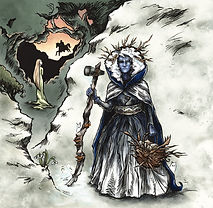
The winter solstice is the height of the Cailleach’s power. She, Manannan and Donn are associated with causing storms. Manannan and Donn are associated with storms at sea, whereas the Cailleach is associated with the storms of winter. Although the Coming of Angus and Bride describes the conditions at the beginning of February through to March, it gives some idea of the Cailleach’s power.
Hunting was one of the few ways to increase food supplies at this time of year. The Cailleach is the guardian of the wild herds and packs such as deer, boar, goats, wolves and wild cattle. In Scotland, there are numerous tales of both the Cailleach’s power over deer and storms. The Lucky Poachers encounter her in a snow-storm when they seek shelter in a bothy. It seems a common part that people wander into her dwelling without realising. The Cailleach in these stories is usually quite hospitable. Preparing and sharing food and giving beds for the night.


Copyright Mike Pennington www.geograph.org.uk
She tells the poachers that her throne is on the top of Ben-y-Gloe (Beinn a’ Ghlo) in the forest of Atholl from where she directs the storm. One of the peaks of the range is called Cairn nan Gabhar, cairn of the Goats. She shows them the rope she uses to unleash the storms. The first knot gives a fair wind that hunters want. The second knot a sweeping blast and the third unleashes a storm that no man can stand against. She extracts a promise of a ‘fat hart or a yeld hind on the first Monday of each quarter’, if the hunters want a good season.[1]
A portion of the hunt is payment for using the Cailleach’s territory and taking the Cailleach’s animals, confirming the principle of reciprocation. In another story a deer eats the Cailleach’s blue yarn and is condemned by her saying ‘the spell is off you’. Later the deer is shot and the blue yarn is found in its stomach. This implies that the Cailleach has some feth fiada she can use to hide game from hunters.
If she is in a bad mood local folklore says she causes cattle to go into bogs, horses to sweat through the night or sheep to worry.
Her treasure, which is another common theme of both Irish and Scottish folklore, leads people to drown in the loch. Her association with old age also associates her with wealth, especially the wealth of the earth both in terms of minerals and food.
The Cailleach guards her territory and her animals fiercely. The Cailleach’s Song is attributed to the Cailleach Beinn Breac, The Hag of the Speckled Mountain. Speckled being an indicator of draoidheachd. In effect the Cailleach tells a hunter to go play in the boiling sea rather than trespass on her territory. She declares she is the ‘monarch of the deer’ and it is her who "defaces heaven’s face with the storm and sublime on dark clouds careers”. She ‘revels in the elemental war’ in her chariot pulled by goats.[2] She sends her voice ‘low through the glens putting fear into the hearts of men’, which may be a reference to mating cries of foxes, which are preparing to breed at this time of year.
One custom in Scotland which links the Cailleach to the sacrifice of cattle and the Mistletoe ceremony is the Calluin.
This tradition was performed on New Years Day but was originally done either at Samhuinn but more likely the Winter Solstice. Revellers would go from house to house. One was dressed in the hide of a cow. The rest would beat the hide with switches bang on walls and sing as they processed deiseal round each house.
“The Calluin of the Yellow Bag of Hide,
Strike the skin, strike the skin,
A Cailleach in the graveyard,
A Cailleach in the corner,
“Another Cailleach beside the fire,
A pointed stick in her two eyes,
A pointed stick in her stomach
“Let me in and open this.”[3]

Each member of the party would repeat a rhyme and the leader would produce a strip of sheepskin wrapped round a stick called the Casein-uchd. This was singed in the fire and each member of the household would inhale the fumes three times. The party would then be given whisky - uisge-beatha, the Water of Life. The purpose was to ensure health and protection for the family for the coming year. Perhaps, the shock of the smell prompted a reaction.
The yellow colour may an allusion to the Yellow Day of Bealltuinn, signifying health of that season brought into the winter. A Cailleach was the name for a nook in a kitchen close to a fire which was often used for the elderly to sleep in. Being close to the fire giving more warmth to those who felt the cold more. The three Cailleach’s mentioned may be metaphors for her roles in death, wealth and healing.
[1] The Art of Deer Stalking, Scrope, W., E. Arnold, 1897
[2] Cailleach Beinn na Bric, S.M.R., 1823, Visions of the Cailleach, D’Este, S. & Rankine, d., Avalonia books 2009
[3] Visions of the Cailleach, D’Este, S. & Rankine, D., Avalonia Books, 2009
SEONAIDH/MANANNAN
Seonaidh, 'the ancient one', is the name of a sea god, probably a local form of Manannan. Three times a year an offering was made in the hope of receiving sea-ware in Leòdhas, Lewis, Outer Hebrides in Scotland. Sea-ware consists of seaweed and other ocean vegetation, which was a vital local fertiliser.[1]
The offering at the Winter Solstice was of a special porridge made from a 'peck of malt' for each family in the district. Barley is one of the few grains that will grow in Winter. However, it has little nutritional value for humans unless it is malted.
The Carmina Gadelica records the offering for other islands in Scotland as well, which became known as 'Diardaoin a Brochain', Porridge Thursday. The ritual was carried out on the Wednesday evening after sunset. A chosen man would wade into the sea until waist-high and pour the porridge out saying a rann, verse.[2]
If the solstice occurred close to the New or Full Moons it caused the highest Spring-tides of the year. If it occurred close to the First or Last Quarters of the moon, it caused the lowest Neap Tides of the year.
Manannan as god of the sea causes the tides by opening and closing his Corr-bolg, Crane-bag.
[1] A Description of the Western Isles of Scotland, Martin, M., Birlin Ltd., 2014 (1703)
[2] Abundance of Seaweed, Carmina Gadelica, vol. I, Floris Books, 2006 (1900)