

LA na CAILLICH - SPRING EQUINOX


ORIGINS OF THE FESTIVAL
Half way between Imbolc and Bealltuinn is the Spring Equinox, which is known as La na Caillich or Day of the Cailleach or Hag. The days have lengthened considerably since Imbolc. Spring is firmly established. The end of March is the time when British clocks go forward an hour to maximise spring and summer light. The equinox is normally the 22nd or 23rd of the Gregorian month, which is just a week after St. Patricks Day. Of course, this could just be a coincidence or it could be an deliberate euhemerization. March 25th was also Lady Day also known as the Feast of the Annunciation. This day was the old New Year's Day in England until the adoption of the Gregorian Calendar in 1752. Romans celebrated the Hilaria Proper on this day in honour of Cybele Magna Mater, Cybele the Great Mother. Cereal goddesses feature throughout Europe at this time of year so its likely Lady Day was an euhemerisation.
Winter storms can last until the end of the first week of March when the weather can be stormy and very cold. After that the sun begins to emerge and the winds calm down. Temperatures during the day are cool but can be freezing at night. Mountains can still get snow flurries. The ground though has generally thawed and is able to be planted.

The Scots Gaelic month name for March is ‘Am Mart’ which means seed-time. Emer wheat takes between 100 and 150 days to fully ripen depending on soil and climatic conditions. The Spring Equinox was the last date to get wheat planted for it to be ripe to harvest in august.
Blessing the seed and making an offering to the land would have been Important for the success of the crops.


Lambing is continuing and calving of cows begins. in order to be born in late March and early April, cows would be 'bulled' from Bealltuinn to the Summer Solstice. I'm a paragraph. Click here to add your own text and edit me. It's easy.


Flowers are blooming all over particularly yellow flowers such as daffodils, primroses, dandelions, golden saxifrage, and marsh marigolds. The yellow colour being symbolic of the returning power of the golden sun. The Blackthorn bears beautiful clusters of white flowers before coming into leaf. Birds are actively singing out the Dawn Chorus as they prepare to mate and nest. Seabirds return to the coasts to nest and pair up after spending months out at sea. Many farmland birds are putting on their mating plumage and snipes are conducting aerial ballets.
One interesting fact about the equinox and possibly why eggs are associated with Easter, is that some birds, such as chickens, need a minimum of twelve hours of daylight to start egg production. The Equinox marks the start of egg laying. These days we use artificial light to stimulate birds into laying.
Young stag, Little belling one
The sound of your voice,
is sweet to us,
Echoing in the glen.
A longing for my tiny house,
Has filled my heart,
The fox in the plain,
The deer in the mountain.
Oak so grand, so full-leaved,
Rising high above the trees,
hazel bush, sweet branching one,
Fragrant your store of nuts.
Alder my friend,
fine in your colour,
Your thorns are not sharp to me,
In the gap where you grow.
Blackthorn, you proud prickly dark plum-bearer,
Watercress, green-topped cluster,
At the edge of the blackbird's well.
Saxifrage of the pathways,
Swetest of all the herbs,
Green,. very green one,
Of the wild strawberries.
Apple tree, fruitful apple,
Roughly do men shake you,
Rowan tree, dear rowan tree,
Beautiful your blossom.
Briar sharp, spiny tooth,
You do not grant fair terms,
You never cease to tear me,
Until you've your fill of blood.
Holly, sheltering one,
Door against the wind,
Ash tree, deadly weap[on,
In the hands of the warrior.
Birch, smooth and blessed,
Proud and melodius,
Beautiful the tracery of your branches,
Reaching to your crest.
Aspen tree that tremble so,
Hearing at times,
The fluttering of your leaves,
I think it is the foray!
Frenzy of Suibhne, Voices from ancient Ireland, Willoughby, B., Pan books
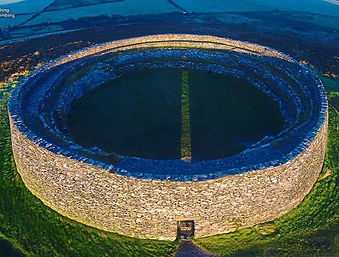
The sun rises due east and sets due west at the equinox, which is an easy way to tell it’s the equinox. Numerous monuments in Ireland and Scotland are aligned with the due east rise; Emain Macha main mound and figure of eight buildings; Grianan throughout Ireland; Dowth and Knowth, which are both associated with the Cailleach are all aligned with eastern entrances.
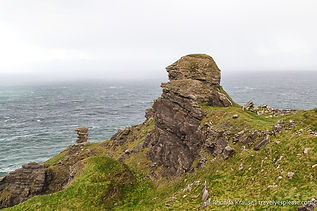
At the Grianan of Aileach the sun penetrates the circle at dawn and the ray of light through the entrance continues to grow until it touches the back wall dividing the circle in half. At the Cliffs of Moher the Cailleach’s head faces due west.
[1] Cattle Management in an Iron Age/Roman Settlement in the Netherlands, Groot, M. et al., Plos One, 2021
THE COMING OF ANGUS AND BRIGHDE
The Coming of Angus and Bride details the battle between the Cailleach and Aonghas. Aonghas brings days of sunshine while the Cailleach brings the wind called ‘The Whistle’ filled with cold and hailstones, which kills sheep lambs horses and cows, for three days. Then she raises the ‘Gobag’, the ‘sharp billed wind’ which pierces and pecks at everything for nine days.
Then she summons ‘The Sweeper’ which tears trees from branches and rips flowers from the earth. All of this results in the ‘Weeks of Leanness’, where fishermen could not venture out. All the time striking the grass with her hammer to stop growth.
“in the night-time Beira and her hags would enter the dwellings of men and stole away their stores of food”
Finally she raises the ‘Gales of Complaint’ which last until the end of the first week in March. At the very last she unleashes the ‘Hog Spirits’, who bring three days of winter to balance the days of summer Aonghas brings at Imbolc, riding black hogs across the sky. However, as Brighid’s power grows, the Cailleach’s wanes. The weakness of old age starts having an effect on her. Aonghas scatters her servants and encloses them in the north, the place of blackness and stone.
The Cailleach casts her hammer under a holly bush, which is why nothing grows under a holly. The Cailleach heads north on ‘her great black steed’, as opposed to Aonghas pure white one, which leaves hoof marks on Loch Etive.
On the morning of the equinox she goes to Beinn na Callich on the Isle of Skye finally admitting defeat. From there she goes to Ireland and turns to stone waiting for her husband Manannan to wake her. Other myths say she goes into a cave, drinks from a fountain of youth and becomes younger again and sleeps for the rest of the year, such as the caves of Lough Crew.[1]
The Equinox marks the final victory of life over entropy. Aonghas Og and Brighid are victorious over the Cailleach. Brighid has imparted so much Brìgh to the earth that the Cailleach can no longer supress it. Youth again has its victory over age as it does at Samhuinn, with the inheritance of the Brugh from the Daghda. The myth shows the Cailleach’s connection to the weather, water, age and the winter. It also shows Aonghas Og as a fierce determined and headstrong warrior just as occurs in other myths involving him such as the raid on Temhair, Tara and in winning the Brugh. Aonghas is a ‘aider’ or ‘helper’ just as he is with Diarmuid & Grainne, the cattle-raids and with Midhir & Eadaoin.
[1] The Coming of Angus and Bride, Wonder Tales from Scottish Myth and Legend, MacKenzie, A., Frederick A. Stokes Co., 1917
A' MHÀTHAIR MHARA - THE SEA MOTHER
The lowest Neap Tides of the year occur at the Waxing or Waning moon closest to the equinox. So Manannan's Corrbolg, Crane-bag, would be closed.
In the Orkneys the Equinox marked the return of the Màthair Mhara, Mother of the Sea. According to Orkney folklore the Màthair Mhara reigns from the Spring to the Autumnal Equinoxes.
She brings with her the warm calm seas of summer and gives sea-creatures the ability to breed and reproduce somewhat akin to the position of Brighid on the land. The sea takes a lot more time to warm up than the land.
Her nemesis is a creature or dragon called Teren, which means ‘furious anger’ in the local dialect. It is Teren who is responsible for storms during the winter. The two battle on the Spring Equinox to see who will reign during the summer months. Màthair Mhara is victorious and chains Teren to the sea-floor.
Summer storms are the result of Teren’s attempts to break free. The power of the Màthair Mhara keeps him imprisoned until the autumn Equinox, when Màthair Mhara is so exhausted he can break free again. She is forced to retreat until the following year. The episode is called the Vore Tullye.[1]
The myth is an aetiological explanation for the weather and sea conditions around the islands. But it repeats the same pattern as in the coming of Aonghas and Bride. The two halves of the year seen as being in opposition to each other only with the sea starting and finishing later than on land.
It has been suggested that there is Scandinavian influence, though no equivalent Norse myth exists. It is possible the Màthair Mhara owes some conception to the Goddess Ran in Norse mythology, though Ran is more associated with causing storms than with stopping them.
[1] Vore Tullye, martinlaird.scot, 2018


Sea Mither & Teren by Carlin Quill www.spookyscotland.net
MAGH MUIRTHEMNE -
THE PLAIN UNDER THE SEA'S ROOF
Being the lowest neap tides of the year, Manannan’s Corrbolg, Crane-bag would be closed. You could argue the opening and closing of the Crane-Bag is the aetiological explanation for the tides, amongst other things. The Corrbolg representing the fertility of the sea just as the Coire Ansaic, the Undry Cauldron or Cauldron of Plenty, represents the fertility of the land.
Another myth which may be applicable for this time of year is the origin of the Plain of Muirthemne.
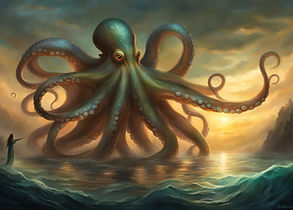
“Mag Muirthemne, whence the name? Not hard to say. The sea covered it thirty years after the Flood, and hence it is called Muirthemne,
that is, ‘darkness of the sea’, or ‘it is under the sea's roof’. Or there was a magic sea over it, and an octopus therein, having a property of suction.
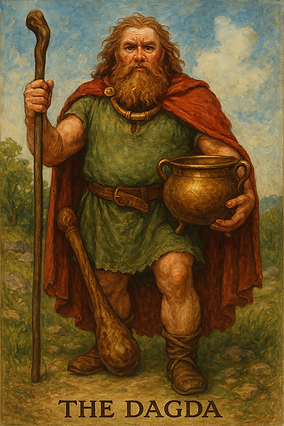
It would suck in a man in armour till he lay at the bottom of its treasure-bag. The Dagda came with his 'mace of wrath' in his hand, and plunged it down upon the octopus, and chanted these words:
“‘Turn thy hollow head! Turn thy ravening body! Turn thy resorbent forehead! Avaunt! Begone!’ Then the magic sea retired with the octopus; and hence, may be, the place was called Mag Muirthemne.”[1]
In other translations octopus is rendered as sea-turtle. Flooding tends to happen from the end of October through to the end of March in the British Isles. We can also have flooding around the time of the Winter Solstice as well.
If the above myth had to be placed in a time frame it would be the end of March when the risk of flooding is receding. The Daghda obtains his ‘Mace of Wrath’ from three brothers after the death of his son Aedh.
While he is High-King after Lugh. The Daghda is presented as the protector of the land against the powerful encroaching sea and guardian against floods.
[1] Metrical Dinnshenchas, Gwynn, E., Royal Irish Academy, 1894
CONNECTION TO IMBOLC AND BEALLTUINN
If the Winter Solstice represents impregnation and Imbolc represents birth then the spring equinox is infancy. A time of growth and learning, discovering everything around us. Life is reaffirmed and well established and the dangers of winter are past.
At Imbolc the coming of new lambs was celebrated whereas at the La na Caillich it’s the coming of calves.
This also makes sense in terms of the Cailleach’s connection to wild cattle, cheese and dairy products and butter in particular. Calves born during this time would be ready to move with the herds and flocks at the transhumance at Bealltuinn.
A time to thank the Brianna, the Gods for surviving the winter and look forward to the joys of summer. A time of planting and of calving to ask the Brianna for their blessings for future prosperity and health. Its also a time to thank the Cailleach for her care of the wild herds - cattle and deer, and her protection of the mountains.